
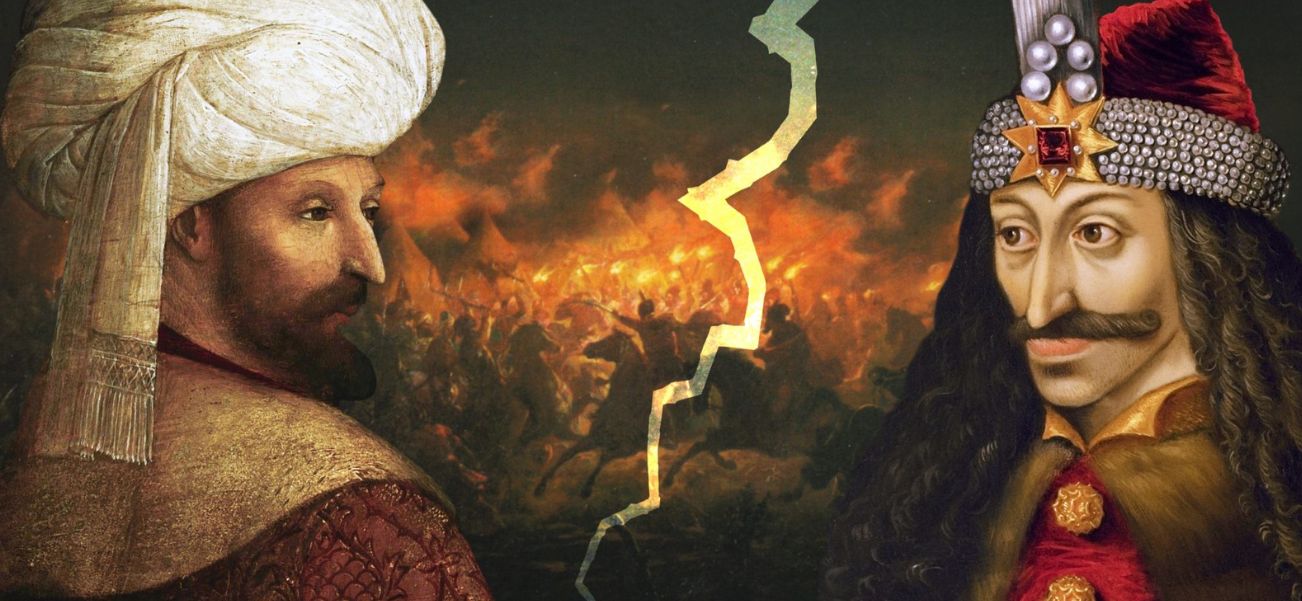
Vlad Dracula and Sultan Mehmed II: Blood, Power, and Empire in the 15th Century
The 15th century was an epoch forged in the crucible of violence, defined by the thunder of siege cannons and the desperate clash of empires and kingdoms. In Eastern Europe, the century witnessed a profound and terrifying shift: the inexorable advance of the Ottoman Empire, a powerhouse of faith, discipline, and imperial ambition, into the heart of the Christian Balkans. In this age of conquest and fear, the stories of two men became permanently intertwined, their conflict transcending mere politics to enter the realms of legend and nightmare. Sultan Mehmed II, the conqueror of Constantinople, and Vlad III of Wallachia, the prince known to history as Dracula, represent a stark, symbolic collision between two worlds, two visions of power, and two masterful wielders of terror.
Their names are often linked in a simple narrative of monster versus emperor, Christian resistance against Islamic conquest. Yet, their true story is far more complex, revealing the brutal intricacies of medieval warfare, diplomacy, and psychological strategy. This is not a tale of clear-cut good versus evil, but of a ruthless, calculated struggle for survival, sovereignty, and dominance on a chaotic frontier. Vlad Dracula and Mehmed II were, in many ways, products of the same violent system, each understanding the currencies of fear, loyalty, and betrayal. By separating the blood-soaked legend from the historical reality, we uncover a gripping chapter that illuminates the very nature of Ottoman imperial power and the fierce, often horrifying, reality of Wallachian resistance. Their confrontation serves as a dark mirror, reflecting the era’s deepest anxieties about empire, identity, and the terrifying cost of defiance.
VLAD DRACULA AND SULTAN MEHMED II: TWO RULERS, ONE VIOLENT CENTURY
Listen to this detailed podcast about "Vlad Dracula and Sultan Mehmed II":
Sacred Anatolia: Religion and Early Christianity in Cappadocia
I. The World They Inherited: Eastern Europe and the Ottoman Rise
To understand the clash between Mehmed and Vlad, one must first survey the fractured, volatile landscape they sought to control. The Balkans in the 1400s were a patchwork of rival kingdoms, principalities, and city-states, often divided by faith (Orthodox and Catholic), ethnicity, and competing dynastic ambitions. North of the Danube lay the principalities of Wallachia, Moldavia, and Transylvania—the latter part of the Kingdom of Hungary. These territories, particularly Wallachia, formed the volatile frontier between Christian Europe and the expanding Ottoman state.

Wallachia’s strategic importance cannot be overstated. It was a buffer zone and a gateway. For the rising Hungarian Kingdom to the north and west, Wallachia was a vital shield against Ottoman incursions. For the Ottomans, controlling or neutralizing Wallachia was essential to securing the Danube frontier, protecting their Balkan holdings, and opening a path for further campaigns into Central Europe. The principality was not a formal part of the Ottoman Empire but existed in a precarious state of semi-autonomy as a vassal state.
This tributary system was the cornerstone of early Ottoman expansion. Conquered or coerced rulers, like the Princes of Wallachia, were required to pay an annual tribute ("harac"), provide military contingents when summoned, and often send their younger sons to the Ottoman court as hostages to guarantee good behavior. This system allowed the Ottomans to project power without the immediate burden of direct administration. However, it bred immense political instability. Wallachian princes ("voivodes") ruled with one eye on their fractious boyar nobility and the other on their Ottoman overlords, their thrones often secured through short-lived alliances, betrayal, and fratricidal conflict. It was into this world of double-dealing, shifting allegiances, and existential threat that both Mehmed II and Vlad III were born.
The Tulip Era of the Ottoman Empire: Luxury, Reform, and the Birth of Modern Istanbul
II. Sultan Mehmed II: The Conqueror of Empires
Sultan Mehmed II, later called "Fatih" (the Conqueror), was the architect of a new imperial vision. Born in 1432, he received a rigorous education from renowned scholars, both Muslim and Christian, fostering a deep interest in history, philosophy, and military science, particularly the campaigns of Alexander the Great and Julius Caesar. From a young age, he was imbued with a singular ambition: to seize the ultimate prize, Constantinople, and establish a universal empire that would succeed both Rome and Byzantium.
His leadership style was a blend of relentless drive, intellectual curiosity, and ruthless pragmatism. Upon his second ascension to the throne, he meticulously planned the campaign that would define his reign and reshape world history: the siege of Constantinople in 1453. The fall of the millennial Byzantine capital was not just a military victory; it was a cataclysmic psychological impact on Europe. It shattered the last remnant of the Roman Empire and announced the arrival of the Ottomans as a preeminent world power. Mehmed consciously styled himself as "Kayser-i Rûm" (Caesar of Rome), moving his capital to Constantinople (Istanbul) and embarking on a vast rebuilding program to transform it into the glorious heart of his Islamic empire.
Mehmed’s approach to governance and expansion was systematic. He implemented significant military reforms, centralizing the famed Janissary corps and becoming a master of siege artillery. His diplomacy was equally calculated. He skillfully played Christian powers against one another, from Venice to Hungary, while his approach to vassal rulers was clear: submit, pay tribute, and provide troops, and you may retain your throne and internal autonomy. Defy the system, however, and the response would be swift, overwhelming, and designed to serve as a lesson to all other frontier lords. He was the embodiment of a new, confident, and terrifyingly efficient Ottoman imperial power.
Constantinople During the Crusades: The Rise, Betrayal, and Fall of Byzantium’s Greatest City
III. Vlad III of Wallachia: The Man Behind Dracula
Against this colossus stood Vlad III, a prince shaped by betrayal and hardened in captivity. Born around 1428/1431, he was the second son of Vlad II Dracul, a member of the Order of the Dragon ("Dracul" meaning “dragon” or “devil”), a chivalric order dedicated to defending Christendom from the Ottomans. Thus, Vlad III was literally a "son of the dragon" or "son of the devil"—"Dracula".
His dynastic background in the House of Drăculești promised little security. Wallachian politics were a deadly game, with the throne contested between rival branches of the Basarab dynasty and powerful boyar families. Vlad’s childhood was defined by the Ottoman threat. His father’s precarious position as a vassal required a gesture of loyalty: around 1442, young Vlad and his younger brother Radu were sent as hostages to the court of Sultan Murad II, Mehmed’s father. This experience was formative. While Radu reportedly thrived, embracing Ottoman culture and earning the epithet “the Handsome” ("Cel Frumos"), Vlad’s captivity was marked by resentment and humiliation. He was, however, given a thorough Ottoman education and political training, learning language, court protocol, military tactics, and the mechanisms of power—knowledge he would later use against his teachers.
Vlad’s rise to power was as bloody as his reign. After his father and elder brother were assassinated by disloyal boyars, Vlad fought for his birthright with a singular ruthlessness. He seized the throne in 1456, and his rule was immediately characterized by a fierce campaign to centralize power and crush internal opposition. It was here that he earned his other, more infamous sobriquet, “Țepeș” (the Impaler). Impalement, a horrific method of execution borrowed from Ottoman and earlier Balkan practices, became his signature tool. Used against treacherous boyars, corrupt merchants, Ottoman envoys, and common criminals alike, it was a brutally effective instrument of terror, justice, and social control, designed to any potential challengers and enforce a draconian order upon his fractured realm.
IV. Hostage to Enemy: Vlad Dracula at the Ottoman Court
The practice of holding the sons of vassal rulers was a cornerstone of Ottoman imperial policy. These Wallachian princes sent to the Ottoman court served as both diplomatic guarantees and indoctrination tools. They were raised in proximity to power, learning to appreciate Ottoman strength and, ideally, developing personal loyalties that would translate into compliant rule.
Vlad and Radu’s time under Ottoman supervision presents a study in contrasts. Radu embraced his new life, becoming a favorite at court, converting to Islam, and forming a close, possibly intimate, friendship with the young Prince Mehmed. Vlad, however, internalized a deep-seated hatred. His captivity was a constant reminder of his father’s subservience and Wallachia’s weakness. The relationship between Vlad and Mehmed II, near-contemporaries, was thus forged in this asymmetrical dynamic of jailer and prisoner, master and hostage. While Mehmed may have seen a potentially useful, if difficult, vassal, Vlad saw the architect of his humiliation.
The psychological and political effects of this captivity were profound. It gave Vlad an intimate, insider’s understanding of Ottoman tactics, court intrigue, and military organization. It also instilled in him a profound paranoia and a belief that survival demanded absolute ruthlessness and the preemptive elimination of threats. This experience shaped Vlad’s later rule in every way: his distrust of his own nobility mirrored his distrust of his Ottoman captors; his use of terror was a stark, amplified reflection of imperial Ottoman methods; and his entire foreign policy would become a personal vendetta against the system that had once held him captive.
V. From Ally to Enemy: The Breakdown of Loyalty
Initially, Vlad’s reign followed the established script of a tributary prince. He acknowledged Ottoman suzerainty and even cooperated with the Ottomans in his early years, securing his throne with their tacit approval. However, the relationship deteriorated rapidly. Several factors fueled the breach.
Firstly, Vlad’s drive for absolute internal control led him to slaughter pro-Ottoman boyars, directly undermining the Sultan’s influence in Wallachia. Secondly, he began to refuse to pay tribute and provide soldiers, the fundamental obligations of vassalage. Instead, he fortified his realm and launched anti-Ottoman campaigns and border raids into Ottoman Bulgaria from 1459 onward, employing guerrilla tactics and impaling captured Ottoman soldiers.
The rising tensions along the Danube frontier became intolerable for Mehmed II, who was preparing for larger campaigns. Vlad’s actions were not just defiance; they were a direct challenge to the legitimacy of the entire tributary system on a critical frontier. Envoys were sent to demand submission. According to legend, when Ottoman messengers refused to remove their turbans in his presence, citing their faith, Vlad had the turbans nailed to their heads. Whether apocryphal or not, the story captures the utter rupture in relations. Vlad was no longer a recalcitrant vassal; he was a declared enemy. Mehmed II’s strategic response was inevitable: a full-scale punitive invasion to remove Dracula and restore a compliant ruler, thereby demonstrating the inexorable cost of defiance to all of Europe.
VI. The Night Attack of Târgoviște (1462): Fear as a Weapon
In the spring of 1462, Mehmed II launched one of the largest military expeditions of his reign, marching into Wallachia with a massive army—estimates range from 60,000 to 100,000 men, including Janissaries, cavalry, and artillery. Vlad, commanding a force perhaps a tenth the size, knew he could not win a conventional battle. Instead, he waged a masterclass in asymmetric and psychological warfare.
He employed scorched-earth tactics, poisoning wells, burning villages, and evacuating the population to deny the Ottoman army sustenance and shelter in the Wallachian summer heat. As the frustrated and weary Ottomans advanced towards the capital of Târgoviște, they encountered a sight of unimaginable horror: the “Forest of the Impaled.” For miles, lining the road, thousands of stakes held the decomposing bodies of Ottoman prisoners, Bulgarian captives, and disloyal Wallachians. Chroniclers describe Mehmed’s army halting in stunned terror before this grotesque display, a calculated act of psychological warfare designed to break their morale.
The campaign’s most dramatic moment was the infamous night attack on the Ottoman camp on June 17, 1462. Guided by local knowledge and aiming for the Sultan’s tent, Vlad and his cavalry launched a daring raid intended to decapitate the Ottoman command. Chaos erupted. Though Mehmed survived (protected, legend says, by a loyal Janissary), the attack caused significant casualties and, more importantly, shattered the aura of Ottoman invincibility. It demonstrated that Vlad could strike even the heart of the colossal army camped on his soil. The effectiveness of this psychological warfare was real; it sowed fear and demonstrated the high cost of conquering Wallachia. However, it could not ultimately overcome the sheer disparity in military power.
VII. Mehmed II Confronts Dracula: Strategy, Shock, and Restraint
Mehmed II’s reaction to Vlad’s tactics reveals the Conqueror’s strategic mind. While undoubtedly enraged and shocked by the impalements and the night attack, he was not ruled by emotion. He recognized that chasing Vlad’s guerrilla force through a devastated landscape was a strategic trap that would bleed his army. Instead, he executed a brilliant and pragmatic maneuver.
Understanding that Vlad’s power base was unstable, Mehmed leveraged a potent weapon: Vlad’s brother, Radu the Handsome. Radu, with his Ottoman backing, charisma, and promise of a return to peaceful (if subservient) relations, appealed to the war-weary Wallachian boyars and populace. Mehmed chose not to pursue total destruction of Wallachia; he sought its stable submission. He installed Radu as the new voivode and withdrew his main army, leaving Radu to fight a civil war for the throne.
This was political pragmatism over revenge. The goal was a stable, compliant Wallachia, not a ruined province requiring costly occupation. By promoting Radu, Mehmed exploited internal divisions and achieved his objective without further major expenditure. This episode also highlighted the limits of fear even for an empire. Vlad’s terror had stalled and shocked the Ottomans, but it had also alienated his own people, making them receptive to Radu’s alternative. Mehmed understood that fear alone could not govern; it had to be coupled with a plausible path to order and stability, which he offered through Radu.
VIII. The Birth of a Monster: Propaganda, Fear, and Dracula’s Image
The story of Vlad Țepeș did not become the legend of Dracula in the Ottoman world, but in Christian Europe. Following his defeat and flight to Hungary in 1462, Vlad was imprisoned by the Hungarian king Matthias Corvinus, who needed to justify his failure to provide major support for Vlad’s war. Thus began one of history’s most effective smear campaigns.
Around 1463, a series of vividly illustrated German pamphlets and early printed propaganda were published, likely with Hungarian encouragement. These pamphlets, such as “The Story of a Bloodthirsty Madman Called Dracula of Wallachia,” detailed atrocities—impalements, mass executions, people boiled alive—with gruesome relish. They circulated widely, feeding Western Europe’s fascination with Vlad’s cruelty. The stories served multiple political purposes: they justified Vlad’s imprisonment, portrayed Matthias Corvinus as a defender of civilization, and highlighted the barbaric “otherness” of the Orthodox East for a Catholic audience.
The portrayals of Vlad were always politically charged. In Orthodox lands, particularly later Romanian chronicles, he was often remembered as a harsh but just ruler who defended his faith and country against overwhelming odds, a necessary tyrant in a time of existential threat. Catholic sources, as seen in the German pamphlets and Hungarian court records, painted him as a monstrous, lawless sadist. His reputation was not a simple record of deeds but a canvas upon which rival powers projected their own fears, prejudices, and political needs. This relentless propaganda began the transformation from ruler to legend, cementing his image not as a failed resistance leader, but as a archetype of inhuman cruelty.
IX. Vlad Dracula vs. Sultan Mehmed II: A Clash of Methods, Not Just Men
At its core, the conflict between these two figures was a clash of methods, not just men. It pitted two diametrically opposed models of power against each other on the bloody frontier.
- Centralized Empire vs Frontier Resistance Mehmed commanded a centralized empire with vast resources, a professional army, and a complex bureaucracy. Vlad led a frontier resistance built on mobility, local knowledge, and the fierce but fickle loyalty of a militarized society.
- Order, Law, and Terror in Governance Mehmed’s terror was systemic and imperial, deployed through laws, taxes, and the disciplined violence of the state. Vlad’s terror was personal and theatrical, a tool of a single ruler to enforce his will instantly and memorably upon a small, unruly realm.
- Military Innovation vs Psychological Warfare Mehmed relied on military innovation—siege cannon, naval power, disciplined infantry. Vlad mastered psychological warfare—scorched earth, night raids, and the strategic use of horrific spectacle to demoralize a superior foe.
- Personal Rule vs Imperial Administration Vlad’s power was intensely personal rule; his state was an extension of his will. Mehmed’s power was embedded in an imperial administration that would function beyond any single sultan’s lifespan.
Their struggle symbolizes an era of transition, where old feudal and tribal loyalties collided with the new, impersonal machinery of the early modern gunpowder empire. Vlad was perhaps the last of a breed: a local warlord whose extreme methods could temporarily check an empire. Mehmed was the future: the architect of a system so robust it could absorb shock, adapt, and ultimately prevail through means beyond the battlefield.
X. Legacy and Myth: From Ottoman Chronicles to Gothic Fiction
The afterlife of these two historical figures diverged spectacularly, shaping modern memory.
- Ottoman Historical Records In Ottoman chronicles, Vlad ("Kazıklı Voyvoda", “the Impaling Prince”) appears as a notable but ultimately minor footnote—a rebellious, cruel, and troublesome border lord who was defeated and replaced. He is a lesson in the consequences of defying the Sultan’s order, not a central figure of fear.
- Romanian National Memory In Romanian national memory, particularly during the 19th-century national awakening, Vlad Țepeș was rehabilitated as a national hero. He was reimagined as a defender of the nation’s independence and Christian faith, a harsh but necessary lawgiver who stood against the Ottoman tide. This view downplays his atrocities as either propaganda or the harsh necessities of war.
- Bram Stoker and Dracula In 1897, Bram Stoker fused the historical name “Dracula” with Eastern European folklore of vampires to create Count Dracula. Stoker’s villainous aristocrat bore almost no relation to Vlad the Impaler beyond the name and a generalized aura of Eastern barbarism. Yet, this Gothic fiction irrevocably merged the historical prince with the immortal vampire in the popular culture of the West, creating one of the world’s most enduring horror icons.
- Mehmed II in Turkish History Mehmed II is remembered in Turkish history as a national titan, the Conqueror, a brilliant statesman and warrior who transformed the Ottoman state into a world empire. He is a symbol of peak Ottoman power, sophistication, and imperial grandeur.
Today, this dual legacy fuels modern tourism in Romania and Turkey. Bran Castle is marketed as “Dracula’s Castle” (despite tenuous historical links), while Istanbul’s Topkapi Palace and the massive Fatih Mosque complex stand as monuments to Mehmed’s vision. Their story persists, a testament to how historical memory is endlessly refashioned to serve the needs of the present, from nation-building to blockbuster entertainment.
XI. Conclusion: Blood, Power, and History’s Dark Mirrors
The brutal encounter between Vlad Dracula and Sultan Mehmed II forces us to look into history’s dark mirrors. Reassessing Vlad Dracula beyond horror myths reveals a complex, brutal, yet comprehensible political actor—a product of captivity, betrayal, and a desperate struggle to forge order in a lawless world. He was neither a cartoonish monster nor a pristine national saint, but a medieval prince who weaponized terror with chilling effectiveness.
Similarly, Mehmed II as a ruler confronting chaos at the frontier is revealed not just as an unstoppable conqueror, but as a calculating strategist who understood that victory often lay in political maneuver as much as in military might. His decision to back Radu over pursuing Vlad was a masterstroke of realpolitik.
What their encounter tells us about power and fear is profound. It demonstrates that terror can be a potent weapon for both the empire and the insurgent, but it is also a fragile one. Unmoored from political strategy and alienating one’s own base, as in Vlad’s case, it becomes self-defeating. Anchored to a system that offers stability, as in Mehmed’s, it can enforce an imperial peace.
This story still fascinates the modern world because it contains timeless elements: the clash of civilizations, the underdog’s defiance, the nature of cruelty, and the manufacture of legend. It is a raw, unfiltered glimpse into a world where survival was the highest law and power was often measured in the capacity to instill dread. In our final reflection, the tale of Dracula and the Conqueror reminds us that the line between legend and historical truth is often drawn not by what happened, but by who tells the story, and why. In their brutal dance of blood and power, both men understood this fundamental truth of history, and both fought to ensure their version would be the one to survive.
Turkish Language Materials