

Constantinople During the Crusades: The Rise, Betrayal, and Fall of Byzantium’s Greatest City
In the annals of medieval history, no city epitomized the confluence of faith, power, commerce, and civilization more than Constantinople. As the capital of the Byzantine Empire—the direct heir to Rome—Constantinople stood for nearly a millennium as the most important metropolis in Christendom. Its strategic position astride the Bosporus Strait made it the ultimate bridge between East and West, a golden gateway linking Europe and Asia, and the spiritual and political heart of Orthodox Christianity.
By the late 11th century, however, this magnificent city found itself at a perilous crossroads. The advent of the Crusades—those great martial pilgrimages launched by Latin Christendom to reclaim Jerusalem—would not only pass through Constantinople’s gates but would ultimately reshape its destiny in ways both profound and catastrophic.
This blog post explores how the Crusades, driven by a volatile mix of religious fervor, political ambition, and commercial greed, systematically dismantled Byzantine power, culminating in the devastating sack of 1204. We will trace how these holy wars transformed Constantinople politically, gutted it economically, and shattered it spiritually, setting in motion the eventual fall of an empire that had stood for a thousand years.
CONSTANTINOPLE AT THE CROSSROADS OF CRUSADE AND EMPIRE
Listen to the podcast about "Constantinople During The Crusades":
I. Constantinople Before the Crusades: The Jewel of the Byzantine Empire
A. The Legacy of Roman and Christian Power
Founded by Emperor Constantine the Great in 330 AD upon the ancient Greek city of Byzantium, Constantinople was conceived as a "New Rome." It was more than a new capital; it was a statement of imperial renewal and Christian triumph. For over seven centuries before the First Crusade, the city flourished as the administrative, cultural, and religious center of the Eastern Roman Empire.
Constantine the Great: From Roman Emperor to Founder of Constantinople
While the Western Roman Empire crumbled in the 5th century, Constantinople endured, preserving Roman law, Greek philosophy, and advanced engineering. The city’s identity was inextricably linked to Orthodox Christianity. The majestic Hagia Sophia, completed in 537 under Emperor Justinian, was the largest church in the world for a millennium, its soaring dome symbolizing the harmony of earthly and divine authority.
The Byzantine Emperor was not merely a ruler but the "Vasileus", God’s representative on earth and the protector of the Christian "oikoumene" (inhabited world). This potent ideology of a universal Christian empire ruled from Constantinople shaped its worldview and its fraught relationship with the rising powers of the West.
B. Wealth, Defense, and Strategic Importance
Constantinople’s wealth was legendary. It controlled the lucrative trade routes between the Black Sea and the Mediterranean, funneling silks, spices, jewels, grain, and slaves from Asia into Europe. Its workshops produced exquisite gold mosaics, silks, ivories, and enamels coveted across the known world. The city’s fabled treasury and relic collections were unmatched. This immense economic power was protected by arguably the most formidable defensive system ever constructed in the pre-gunpowder era: the triple-layered Theodosian Walls.
Stretching 4 miles from the Sea of Marmara to the Golden Horn, these 40-foot-tall fortifications, with their 96 towers and deep moats, rendered the city virtually impregnable for centuries. Together with its secret weapon, “Greek Fire”—a napalm-like incendiary compound—Constantinople presented an image of invincible, opulent power. To medieval Western Europeans, it was a place of almost mythical splendor, a city of gold whose streets were paved with marble and whose churches held the holiest relics of Christendom.
II. The First Crusade (1096–1099): Uneasy Allies at the City Gates
A. Arrival of the Crusaders
When Pope Urban II preached the First Crusade in 1095, his call to arms resonated across Western Europe. The first to arrive at Constantinople’s outskirts in 1096, however, were not disciplined knights but the chaotic, poorly-armed mob of the “People’s Crusade” led by Peter the Hermit. Emperor Alexios I Komnenos, a shrewd and capable ruler, viewed them with alarm. He provided them with supplies but quickly ferried them across the Bosporus into Anatolia, where they were massacred by the Seljuk Turks.
The arrival of the main feudal armies later that year presented a different, but equally serious, challenge. To Alexios, these tens of thousands of well-armed Latin warriors, with their own ambitious leaders like Bohemond of Taranto and Godfrey of Bouillon, represented a potential threat to his own sovereignty as grave as any Muslim army.
B. Emperor Alexios I Komnenos and Diplomatic Tension
Alexios’s primary goal was to use Crusader military power to recapture former Byzantine territories in Anatolia lost to the Turks, not to facilitate a grand march to Jerusalem. He demanded that the Crusader leaders swear an oath of fealty ("horkios") to him, promising to return any reconquered lands to imperial control. In return, he offered guides, supplies, and military support.
This created immediate tension. For the Byzantines, this was a standard feudal arrangement for allied forces. For many Crusaders, it was an affront to their sense of independent, God-guided mission. Reluctantly, most leaders took the oath, though with mental reservations that foreshadowed future betrayals.
C. Cooperation and Distrust
Despite the underlying suspicion, the First Crusade featured periods of crucial Byzantine-Crusader cooperation. Alexios provided essential logistical support during the difficult siege of Antioch in 1098. However, when the Crusaders, having taken the city, refused to hand it over as per their oath, the fissure widened. The Byzantines saw this as typical Latin perfidy. The Crusaders, for their part, accused Alexios of abandoning them when his relief force turned back before reaching Antioch.
This mutual accusation of betrayal became a toxic trope that would poison relations for the next century. Yet, the Crusade succeeded in its primary objective, capturing Jerusalem in 1099. For Byzantium, the result was bittersweet: a powerful new set of Latin states (the Crusader kingdoms) now bordered its territory, led by men whose loyalty was questionable at best.
III. Between Crusades: Constantinople as a Political Chessboard
A. Byzantium’s Declining Military Power
The 12th century revealed the Byzantine Empire’s growing vulnerabilities. The Komnenian emperors after Alexios I struggled with constant pressure on all frontiers: Normans from Sicily, Seljuk Turks in Anatolia, and Pechenegs and Cumans in the Balkans.
Internally, the empire’s once-robust thematic military system had eroded, replaced by an increasing reliance on expensive foreign mercenaries, including many Latins (Western Europeans). This dependence drained the treasury and created a dangerous precedent, embedding Latin soldiers and commanders within the very heart of Byzantine power structures.
B. Growing Latin Presence in Constantinople
Economic factors deepened the crisis. In exchange for naval support, Emperor Alexios I had granted Venetian merchants extensive trading privileges ("chrysobulls") in 1082, exempting them from tariffs and granting them their own quarter in Constantinople. Genoese and Pisan traders soon secured similar deals.
These Italian maritime republics established vibrant, semi-autonomous enclaves along the Golden Horn, dominating Byzantine commerce. Their economic dominance bred deep resentment among the city’s Greek populace, who saw their livelihoods threatened and their city overrun by arrogant foreigners. Periodic mob violence against the “Latins” flared up, most notably in 1182 when a massacre of thousands of Latins in Constantinople created a legacy of bitter hatred.
C. Religious Tensions
The theological and cultural rift between the Greek Orthodox East and the Latin Catholic West, formalized by the mutual excommunications of 1054 (the Great Schism), simmered beneath every interaction. Greeks viewed Latins as theologically crude, lacking in proper reverence, and spiritually arrogant.
Latins saw Greeks as schismatic, duplicitous, and weak—unreliable allies in the fight for Christendom. The presence of Latin churches and clergy in Constantinople, and Byzantine resistance to papal authority, made religion a constant source of friction, turning theological differences into a potent political weapon.
IV. The Second and Third Crusades: Strategic Tensions and Broken Trust
The passage of the Second Crusade (1147-1149) under King Conrad III of Germany and King Louis VII of France through Byzantine territory was a disaster for East-West relations. Emperor Manuel I Komnenos, fearful of such a large army, insisted they cross the Bosporus quickly and provided questionable guides.
The Crusaders, for their part, plundered the countryside and clashed with Byzantine forces. Mutual accusations of sabotage and betrayal flew. The Crusade’s ultimate failure at Damascus was blamed by many in the West on Byzantine treachery.
The Third Crusade (1189-1192), aimed at recapturing Jerusalem after Saladin’s victories, further strained ties. The German contingent under the formidable Frederick I Barbarossa marched through the Balkans, openly hostile to the Byzantine Emperor Isaac II Angelos, whom Frederick suspected of an alliance with Saladin.
The Germans occupied Adrianople, threatened Constantinople, and only crossed into Anatolia after intense diplomacy. The mistrust was now entrenched. In the Western narrative, Byzantium was no longer a flawed brother in faith but a treacherous obstacle to the holy cause, more interested in deals with Muslims than in Christian solidarity.
V. The Fourth Crusade (1202–1204): The Road to Catastrophe
A. How a Crusade to Jerusalem Turned Toward Constantinople
The Fourth Crusade, called by Pope Innocent III, became history’s most infamous act of diversion. Its original target was Egypt, the heart of Muslim power. Financial and logistical problems, however, placed the Crusade at the mercy of the Venetian Republic, which built a vast fleet for a steep price of 85,000 silver marks. When the Crusaders could not pay the full amount, the aged, blind, and ruthless Doge Enrico Dandolo offered a deal: the Crusade would help Venice subdue its rebellious Adriatic rival, the Christian city of Zara (Zadar), as payment.
Despite papal excommunication for attacking a Christian city, they complied. Then, a Byzantine claimant to the throne, Prince Alexios Angelos, son of the deposed Isaac II, arrived with a tantalizing offer: if the Crusaders restored his father and him to the throne in Constantinople, he would pay them a fortune, supply the entire Crusade, and place the Byzantine Church under papal authority. Driven by debt, Venetian commercial ambition, and the lure of imperial gold, the Crusade fleet set sail for Constantinople.
B. Political Chaos Inside Constantinople
The city the Crusaders approached in June 1203 was politically fractured and militarily unprepared. The ruling emperor, Alexios III Angelos, was incompetent and unpopular. The imperial military was a shadow of its former self, and the famed walls, though still mighty, were undermanned. The populace was divided, with some favoring the young Alexios (IV) and others fiercely opposed to any Latin intervention.
When the Crusaders installed Alexios IV as co-emperor, he found the treasury empty and could not fulfill his extravagant promises. Resentment against the Latins and their puppet emperor boiled over. In January 1204, Alexios IV was overthrown and strangled by a nationalist leader, Alexios V Doukas, who refused any further dealings with the Crusaders.
C. The Sack of Constantinople (1204)
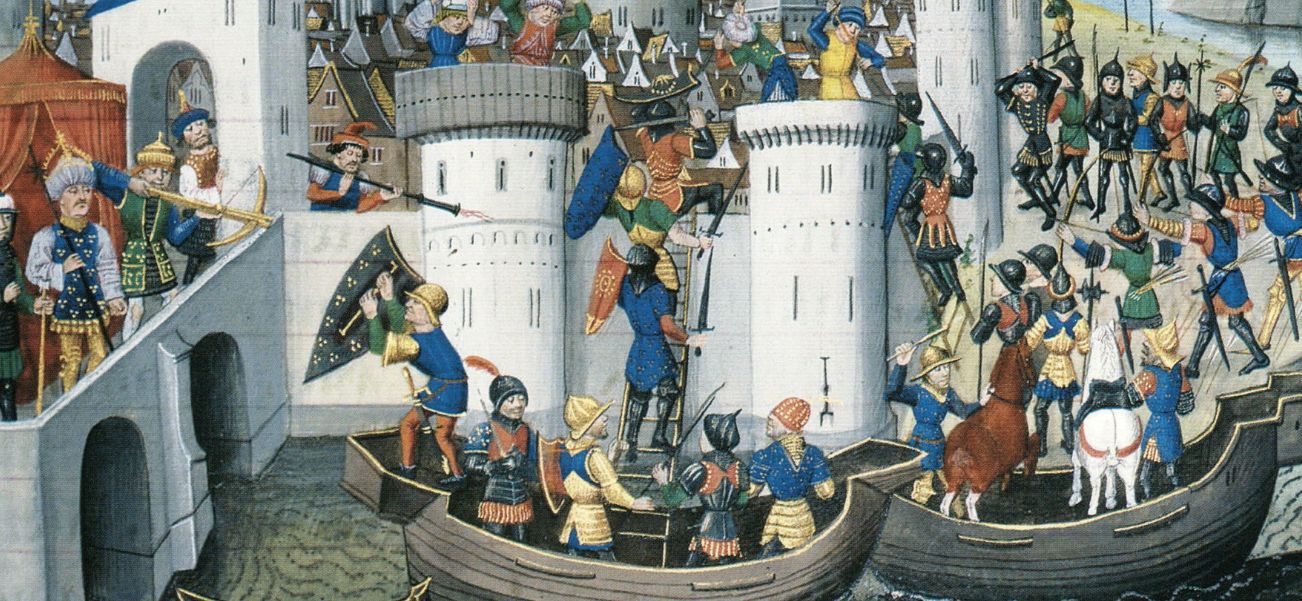
Trapped, unpaid, and facing a hostile city, the Crusader and Venetian leaders made a cold-blooded decision: to conquer and partition the Roman Empire itself. On April 12, 1204, after a short siege, Crusader forces breached a section of the sea walls along the Golden Horn.
The next day, they poured into the city. What followed was not a military occupation but an orgy of destruction that lasted for three days. The Sack of Constantinople stands as one of the most destructive acts of cultural vandalism in history.
- Looting of Churches and Palaces Crusaders and Venetians stripped the Hagia Sophia of its altars, icons, and holy relics. The magnificent bronze horses from the Hippodrome were sent to adorn St. Mark’s Basilica in Venice. Countless other churches, monasteries, and the Great Palace were systematically plundered.
- Destruction of Art and Manuscripts Priceless classical statues were melted down for their bronze. Incalculable numbers of ancient and medieval manuscripts, preserving the works of Greek and Roman authors, were burned or lost. The literary and artistic losses were catastrophic.
- Atrocities Against Civilians The Latin soldiers, whom the Byzantines had derided as barbarians, proved the point with horrifying violence. They raped, murdered, and tortured the citizens of the very city they had come to as Christian allies. Nuns were violated on altars, and homes were ripped apart in the search for hidden wealth. The contemporary historian Niketas Choniates wrote in despair of “the felling of the sacred images and the casting of the relics of the saints… into defiled places.”
The city that had been the guardian of classical and Christian civilization for 874 years was left smoldering, desecrated, and humiliated.
VI. The Aftermath: Latin Rule and the Shattered Byzantine World
A. Establishment of the Latin Empire
The victors formally divided the empire according to the pre-sack “Partitio Romaniae.” Count Baldwin of Flanders was crowned Emperor of a new “Latin Empire of Constantinople,” a feeble state controlling only the city and parts of Thrace. Venice claimed three-eighths of the city, including Hagia Sophia, and a web of strategic ports and islands, creating a commercial maritime empire. The rest of Byzantium’s territories were parceled out into feudal fiefs for Crusader knights, though much remained in the hands of resisting Greeks.
B. Impact on the Population
For the people of Constantinople and the empire, the catastrophe was total.
- Mass Displacement The aristocracy, scholars, artists, and clergy fled the city in droves, carrying their learning and culture to exile courts in Nicaea, Epirus, and Trebizond.
- Economic Collapse The commercial dominance of the Italian republics was now absolute. The Byzantine economy, once a complex, state-managed system, was shattered and feudalized.
- Religious Persecution A Latin patriarch was installed, Orthodox clergy were expelled, and churches were forcibly converted to perform the Latin rite. The spiritual trauma of seeing their sacred spaces defiled deepened the chasm between the churches immeasurably.
C. Long-Term Damage to Byzantine Power
The empire was irrevocably fragmented. Three major Greek “successor states” emerged: the Empire of Nicaea in Asia Minor, the Despotate of Epirus in Greece, and the Empire of Trebizond on the Black Sea coast. Each claimed the mantle of Rome, but they often fought each other as much as the Latins.
The Fourth Crusade destroyed the centralizing power, wealth, and mystique of the Byzantine state. It proved that the city could be taken, shattering the myth of its invincibility and providing a blueprint the Ottomans would study a century later.
VII. The Recapture of Constantinople (1261): A City Forever Changed
On July 25, 1261, a small advance force of the Empire of Nicaea, under General Alexios Strategopoulos, found an unguarded postern gate in Constantinople’s walls and slipped into the city. The last Latin emperor, Baldwin II, fled without a fight. Michael VIII Palaiologos, the Nicaean emperor, entered in triumph and was crowned in Hagia Sophia, restoring Byzantine rule after 57 years of Latin occupation.
But the restored Constantinople was a ghost of its former self. The population had plummeted from perhaps 400,000 in 1200 to less than 50,000. Vast areas within the mighty walls were now empty fields and ruins. The treasury was empty, the navy nonexistent, and the economy was strangled by Venetian and Genoese monopolies (the Genoese were granted the district of Galata as a reward for their aid).
The restored empire was a small, poor state in constant civil war, surrounded by enemies. It survived for another 200 years not through strength, but because its neighbors were distracted. The city had been recovered, but its power and glory were gone forever.
VIII. Constantinople’s Crusader Legacy: A Turning Point in History
A. East–West Relations After 1204
The sack of 1204 created a permanent rupture. For the Orthodox world, especially the Russians, the Latins were not just heretics but “God-fighting destroyers.” The idea of reuniting the churches, often pushed by Byzantine emperors seeking Western military aid, was now politically impossible—the populace would prefer, as many said, “to see the Turkish turban in the city than the Latin mitre.” The Crusades, meant to defend Christendom, had irrevocably split it in two.
B. Paving the Way for Ottoman Conquest
The Fourth Crusade is the pivotal event that made the Ottoman conquest of 1453 inevitable. It destroyed the structural, economic, and demographic foundations of the Byzantine state. The empire was reduced to a rump state, chronically unstable and unable to defend its borders.
When the Ottoman Turks rose in the 14th century, they expanded into a power vacuum the Crusades had created. The walls that had held for a thousand years finally fell to Mehmed the Conqueror’s cannon in 1453 in part because the empire that manned them had never recovered from the devastation of 1204.
C. Lessons from Constantinople’s Crusader Era
The tragedy of Constantinople during the Crusades is a masterclass in the unintended consequences of geopolitics. It demonstrates how short-term opportunism (Venetian greed, Crusader debt), cultural arrogance, and the weaponization of religious difference can lead to catastrophic self-destruction. The West did not gain a loyal ally or a secure route to Jerusalem; it destroyed the chief bulwark of Christendom in the East. Byzantium, for its part, failed to navigate the rising power of the West, its internal divisions and arrogance making it vulnerable to manipulation.
IX. Conclusion: The Crusades and the Fall of an Empire’s Heart
The experience of Constantinople during the Crusades is a story of rise, betrayal, and irreversible fall. From the uneasy alliance of the First Crusade to the apocalyptic sack of the Fourth, the city was slowly bled dry—of its wealth, its political cohesion, and finally, its very soul. While the Ottoman conquest of 1453 provides a dramatic endpoint, many historians argue that 1204 was the true death knell for the Byzantine Empire. The physical conquest and looting in 1453 was, in a tragic sense, merely the burial of a body that had been mortally wounded 250 years earlier by its Christian brethren.
Constantinople’s fate stands as a cautionary tale of how internal weakness—political strife, economic dependency, and military decline—can invite catastrophic external intervention. The Crusades, which passed through the Queen of Cities as both supplicants and conquerors, reshaped the medieval world by ensuring that when a new, powerful force arose in the East, there would be no strong, unified Christian empire left to stop it. The greatest city of the Middle Ages was ultimately betrayed not just by the ambition of outsiders, but by the crumbling of the ancient world order it had so magnificently embodied.
Turkish Language Materials