

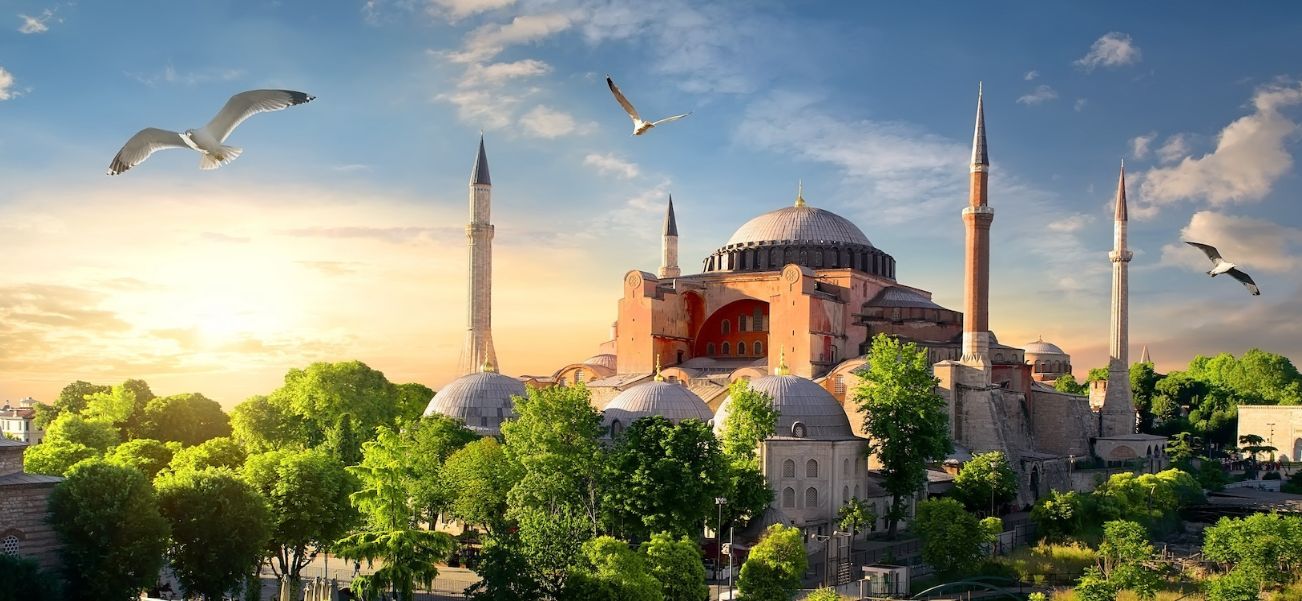
Hagia Sophia: The Timeless Symbol of Istanbul's Spiritual and Imperial Legacy
To step into Hagia Sophia is to feel the weight of history breathe. The air is cool and thick with the scent of ancient stone and old incense. Your gaze is first stolen by the impossible scale—the dome, a golden heaven seemingly suspended by divine will alone, pierced by forty windows of ethereal light. Then, your eyes adjust to the layers: shimmering Byzantine mosaics of Christ and emperors peer from shadows, while giant Ottoman calligraphic medallions inscribed with the names of Allah, the Prophet Muhammad, and the caliphs hang solemnly in the vastness. This is not merely a building; it is a palimpsest of human aspiration, a physical manuscript where empires, faiths, and epochs have written and rewritten their stories in marble, gold, and light.
Hagia Sophia stands as the ultimate witness. For over 1,500 years, it has watched over a city that has been the capital of two of history’s most formidable empires: the Christian Byzantine and the Islamic Ottoman. Its own life has been one of transformative resilience: a Great Church of Christendom for 916 years, an Imperial Mosque of a global caliphate for 481 years, a secular museum celebrating shared human heritage for 85 years, and, as of 2020, an active mosque once again. Each transition was seismic, reflecting shifts in world power, ideology, and faith.
More than a museum or a place of worship, Hagia Sophia is the soul of Istanbul. It represents the city’s unique, layered identity, where East meets West not as a cliché but as a lived, tangible reality. It remains one of the world’s most important and visited monuments, not just for its architectural genius but for its unparalleled narrative—a story of conquest, devotion, artistry, and coexistence that continues to evolve. It is a timeless symbol, asking us to contemplate the enduring nature of sacred space and the complex, often contested, legacy of human civilization.
HAGIA SOPHIA: THE TIMELESS SYMBOL OF ISTANBUL
Listen to this audio book about the Hagia Sophia, Istanbul's iconic marvel blending Byzantine & Ottoman heritage.
RECOMMENDED READING The Ultimate Istanbul Travel Guide: Discover The Soul Of Two Continents
1. What Is Hagia Sophia? A Brief Overview

"Hagia Sophia" (pronounced "Aya Sofya" in Turkish) translates from Greek as “Holy Wisdom,” a central concept in Eastern Christian theology referring to the divine, personified wisdom of God. It is not dedicated to a saint named Sophia, but to this sacred, abstract principle. This name sets the stage for a building intended to embody celestial intellect and glory on earth.

Strategically located in Istanbul’s Historic Peninsula, at the very tip where the Golden Horn meets the Sea of Marmara and the Bosphorus Strait, Hagia Sophia has always been the centerpiece. It sits directly across from the Blue Mosque in Sultanahmet Square, the ancient heart of Constantinople. For centuries, its dome was the first sight for sailors approaching the city and the axis around which imperial and religious life revolved.

Its role has always been triple-fold: as a political symbol of imperial authority (Byzantine Emperors were crowned here, Ottoman Sultans prayed here after conquests), a religious epicenter for two major world faiths, and an architectural archetype that forever changed the history of building design. This unique value was recognized globally when it was inscribed as a UNESCO World Heritage Site in 1985 as part of the “Historic Areas of Istanbul,” lauded for its unique fusion of architectural traditions and its profound influence.

2. The Birth of a Byzantine Masterpiece
The First Churches on the Site

The current Hagia Sophia is the third religious structure to stand on this hallowed ground. The first, known as the "Magna Ecclesia" (Great Church), was a traditional Roman basilica commissioned by Emperor Constantine I, the founder of Constantinople, and dedicated in 360 AD. It was built atop a pagan temple, a common practice symbolizing Christianity’s triumph. This wooden-roofed structure was burned down during riots in 404. Its replacement, built by Emperor Theodosius II in 415, suffered a similar fate during the devastating Nika Riots of 532, which nearly ended Emperor Justinian’s reign.
Emperor Justinian and the Great Vision

The destruction presented an opportunity. Emperor Justinian I, determined to reassert his power and create a monument to God that would eclipse all others, commissioned a revolutionary new building just 39 days after the riots. He chose two theoreticians rather than traditional builders: the mathematician Anthemius of Tralles and the geometer Isidore of Miletus. Their task was unprecedented: to construct the largest, most magnificent house of worship in the Christian world. With immense resources plundered from across the empire and a workforce of over 10,000 men, the project was completed in a staggering five years, ten months, and four days, consecrated on December 27, 537.
The World’s Largest Cathedral

Upon its completion, Hagia Sophia was the largest enclosed space in the world. It would hold the title of the world’s largest cathedral for nearly 1,000 years, until Seville Cathedral was completed in 1520. The legend goes that when Justinian first entered the finished sanctuary, he was struck with awe and declared, “Solomon, I have surpassed thee!” referencing the biblical Jewish Temple in Jerusalem. He had not just built a church; he had constructed a definitive statement of Byzantine imperial and theological supremacy.
3. Architectural Genius: A Revolution in Design
The Dome That Changed Architecture

The central challenge and triumph of Hagia Sophia is its monumental dome. Spanning 31 meters (102 feet) in diameter and rising 56 meters (184 feet) high, it was an engineering marvel that seemed to defy gravity. The architects’ genius lay in using pendentives—curved triangular segments that transition the square base of the building to the circular base of the dome. This was a revolutionary breakthrough, allowing for a much larger and taller dome than the previous Roman half-dome techniques. The effect is one of miraculous suspension; Procopius, Justinian’s court historian, wrote that the dome seemed not to rest on solid masonry, but to be “suspended from heaven by a golden chain." The ring of forty windows at the dome’s base creates a dazzling halo of light, furthering the illusion that the dome is floating.
Materials From Across the Empire

Justinian sourced materials from the length and breadth of his realm to manifest his empire’s wealth and universality. Eight magnificent porphyry columns were hauled from the Temple of the Sun in Baalbek, symbolizing imperial power. Green marble columns came from Ephesus, and yellow stone from North Africa. The interior is sheathed in rare marbles: white from Marmara, green from Thessaly, pink from Synnada, and yellow from Algeria. These were cut and book-matched to create mesmerizing symmetrical patterns, like a vast, polished stone tapestry. The floor was paved with Proconnesian marble, worn smooth by millions of footsteps over centuries.
Light, Space, and Acoustics

The architects masterfully manipulated light and space to create a transcendent atmosphere. Light filters not only from the dome but from countless windows in the side walls and galleries, dissolving the solidity of the structure. This “dematerialization” was intentional, creating a sense of heavenly, immaterial space. The acoustics were equally considered. The vast, reverberant space was designed to amplify the Byzantine chant, with its sustained, ethereal tones, making the human voice sound angelic and omnipresent. The building itself was an instrument for worship.
4. Sacred Art: Mosaics and Christian Iconography

The original interior was a blaze of color and gold, with over four acres of mosaics. While many were lost to periods of Iconoclasm (8th-9th centuries), when figurative art was banned, and later plastered over by the Ottomans, surviving masterpieces reveal unparalleled artistry. Created from thousands of tiny cubes of glass, stone, and gold leaf ("tesserae"), they were designed to glitter in the candlelight.
Key surviving mosaics include:
- The Deesis Mosaic (South Gallery) A 13th-century masterpiece depicting a pleading Virgin Mary and John the Baptist beside a compassionate Christ Pantocrator. Its emotional depth and artistic refinement are unmatched.
- Imperial Portraits Panels showing emperors and empresses offering gifts to Christ or the Virgin, such as the Empress Zoe mosaic and the Comnenus mosaic, which blend portraiture with divine homage.
- The Virgin and Child in the apse: Re-instated after Iconoclasm, this majestic figure of the Theotokos (God-bearer) sits enthroned, the focal point of the entire chancel.
These mosaics were not mere decoration; they were a theological language, depicting the hierarchy of heaven and earth and the divine authority bestowed upon the Byzantine emperor.
5. The Ottoman Conquest and Islamic Transformation
1453: Constantinople Becomes Istanbul

On May 29, 1453, Sultan Mehmed II, “the Conqueror,” entered the fallen city of Constantinople. His first act was to ride to Hagia Sophia. He dismounted, bowed in prayer, and transformed the great cathedral into his imperial mosque, the Ayasofya-i Kebir Camii. This act was profoundly symbolic: the spiritual heart of the Byzantine Empire was now the center of the new Ottoman Islamic order. The first Friday prayer was held there just days later, with Mehmed himself leading the congregation.
Ottoman Additions

The Ottomans, in awe of the structure, preserved it but adapted it for Islamic worship with respectful additions:
- Minarets Four elegant minarets were added over time (one by Mehmed II, others by later sultans), transforming the skyline and balancing the massive central dome.
- Mihrab and Minbar A mihrab (prayer niche indicating Mecca) was installed in the apse, slightly off-axis to align with Mecca, and a finely carved minbar (pulpit) was added.
- Calligraphic Panels In the 19th century, master calligrapher Kazasker Mustafa İzzet Efendi created the iconic eight massive roundels that hang in the main space, bearing the names of Allah, Muhammad, the first four caliphs, and the prophet’s grandsons.
- Architectural Influence Hagia Sophia directly inspired the great Ottoman mosques, most notably the Blue Mosque (Sultan Ahmed Mosque) across the square, which can be seen as a direct architectural response and homage.
Preservation Rather Than Destruction

Contrary to popular belief, the Ottomans did not destroy the Christian mosaics. Following Islamic tradition, which often discourages but does not mandate the destruction of figurative religious art in converted spaces, they were carefully covered with plaster. This act of concealment, paradoxically, preserved them for centuries, protecting them from moisture, vandalism, and the wear of time, allowing for their stunning revelation in the 20th century.
6. From Mosque to Museum and Back Again
The Secular Era

With the fall of the Ottoman Empire and the birth of the secular Republic of Turkey under Mustafa Kemal Atatürk, Hagia Sophia’s fate shifted again. In 1935, the Council of Ministers decreed its conversion into a museum. This was a monumental decision aimed at “presenting it to humanity,” emphasizing its universal historical value over its religious function. American archaeologist Thomas Whittemore was permitted to lead a restoration, carefully uncovering the long-hidden Byzantine mosaics. For 85 years, it stood as the Hagia Sophia Museum, a powerful symbol of Turkey’s secular modernity and a neutral ground where its layered heritage could be appreciated by all.
2020 Reversion to a Mosque

In July 2020, following a Turkish high court ruling that annulled the 1934 cabinet decree, President Recep Tayyip Erdoğan ordered Hagia Sophia to be reopened for Muslim worship. This highly symbolic decision was framed as an assertion of Turkish sovereignty and a reclamation of Islamic heritage. International reactions were mixed, with UNESCO expressing concern and calls for preservation from religious and cultural leaders worldwide. Currently, it functions as an active mosque (Ayasofya-i Kebir Camii Şerifi). Christian mosaics are covered with curtains during prayer times but visible otherwise. Entry remains free, and non-Muslim visitors are welcome outside of the five daily prayer times, though the central nave carpet for prayer and the partial covering of imagery has altered the museum-like viewing experience.
7. Visiting Hagia Sophia Today: Practical Travel Guide

Location and How to Get There
Hagia Sophia is located in the heart of Sultanahmet Square, Fatih, Istanbul. The most convenient way to arrive is by taking the T1 Bağcılar-Kabataş tram line and disembarking at the Sultanahmet stop. From there, it is a one-minute walk. The building is impossible to miss, dominating the square alongside the Blue Mosque and the ancient Hippodrome.
Entry Rules and Dress Code
- Entry Free of charge for all visitors.
- Hours Open 24/7 as a mosque, but closed to non-worshippers during the five daily Muslim prayer times (which change daily, check local schedules). Typical tourist access is from 9:00 AM until one hour before evening prayers.
- Dress Code Modest dress is required for all. Women must cover their heads with a scarf (available at entrance if needed). Shoulders, arms, and legs down to the ankles should be covered for both men and women. Shoes are removed and carried in a provided bag before entering the carpeted prayer area.
- Access The entire main floor is open, but the upper galleries are often closed to tourists since the reversion to a mosque. The historic Christian mosaics in the galleries may not be accessible.
Best Time to Visit
To avoid the largest crowds, arrive early in the morning right at opening, or later in the afternoon. Avoid Friday midday prayers, when the mosque is busiest with worshippers. Visiting in the winter or shoulder seasons (fall/spring) also offers a less crowded experience. The morning light through the windows is particularly stunning for photography.
8. Hagia Sophia’s Cultural and Spiritual Legacy

Hagia Sophia’s legacy transcends religion and architecture. It is a profound symbol of layered history and potential coexistence. It demonstrates how sacred spaces can accumulate meaning, adapt, and remain central to human identity across civilizations. Architecturally, its innovative use of the pendentive dome created a template that influenced Byzantine churches for a millennium and Ottoman mosques for over 500 years, its form echoing from Rome to St. Petersburg.
It matters because it forces a confrontation with history in all its complexity—glorious, turbulent, and continuous. It is a monument to human genius, to the universal search for the divine, and to the often painful but enduring dialogue between cultures. In a world often divided, Hagia Sophia stands as a permanent, stone-and-mortar question about what we choose to preserve, what we transform, and how we share our common heritage.
9. Hagia Sophia vs Blue Mosque: What’s the Difference?

While facing each other in Sultanahmet Square, these two icons offer distinct experiences:
- Historical Purpose Hagia Sophia was built as a Christian cathedral (537 AD) and later became a mosque. The Blue Mosque was built as a mosque from its foundation (1609-1617 AD).
- Architecture Hagia Sophia is a unique, revolutionary hybrid of a central dome on pendentives, a masterpiece of late antiquity. The Blue Mosque is a classic example of mature Ottoman architecture, consciously inspired by Hagia Sophia but also by the work of Sinan, featuring a cascade of domes, semi-domes, and six slender minarets.
- Interior Hagia Sophia’s interior is a fusion: Christian mosaics and Islamic calligraphy over ancient marble. The Blue Mosque’s interior is a coherent Islamic masterpiece, famed for its tens of thousands of hand-painted İznik blue tiles (giving it its Western name), stained glass, and intricate calligraphy.
- Visitor Experience Hagia Sophia is a living mosque with a museum’s history, where the layers are visible and the function active. The Blue Mosque is also an active mosque but functions more like a pure, working house of worship with a unified aesthetic. Both require respectful dress, but only Hagia Sophia requires head covering for women (the Blue Mosque provides cover-ups but not always headscarves).
Conclusion: A Monument Beyond Time

Hagia Sophia is not a relic frozen in the past; it is a living, breathing monument that continues to participate in history. Its stones hold the echoes of Byzantine chants and Ottoman prayers, of imperial coronations and republican reforms. It is the enduring core of Istanbul’s identity—a city that is neither wholly European nor wholly Asian, but a magnificent synthesis.
To visit Hagia Sophia is to undertake a journey through time, faith, and human achievement. It challenges the visitor not just to see, but to contemplate the flow of empires and the persistence of the sacred. It is a place where light, architecture, and history converge to create something that remains, after fifteen centuries, utterly awe-inspiring. It is, quite simply, a building that every traveler must experience at least once to feel the profound, timeless pulse of human civilization.
FAQ Section
Is Hagia Sophia free to visit?
Yes, since its reversion to a mosque in 2020, admission is completely free of charge for all visitors.
Is Hagia Sophia a mosque or museum?
As of July 2020, Hagia Sophia is officially a mosque (Ayasofya-i Kebir Camii Şerifi). Its previous status as a museum (1935-2020) was revoked. It is now a functioning place of Muslim worship that is also open to tourists.
Can non-Muslims enter Hagia Sophia?
Yes, non-Muslims are welcome to visit Hagia Sophia outside of the five daily Muslim prayer times. Visitors must adhere to the modest dress code and behave respectfully as it is an active house of worship.
What is the best time to visit Hagia Sophia?
The best time is early in the morning right after it opens to tourists, or in the late afternoon. Avoid midday and Friday prayers. The winter months (November-February) also see fewer crowds.
How old is Hagia Sophia?
The current building was completed in 537 AD, making it over 1,486 years old (as of 2023). It is one of the oldest and most continuously significant buildings in the world.
ARE YOU LEARNING TURKISH?
Learn Turkish yourself with Dem Turkish Center!
Turkish Language Materials