


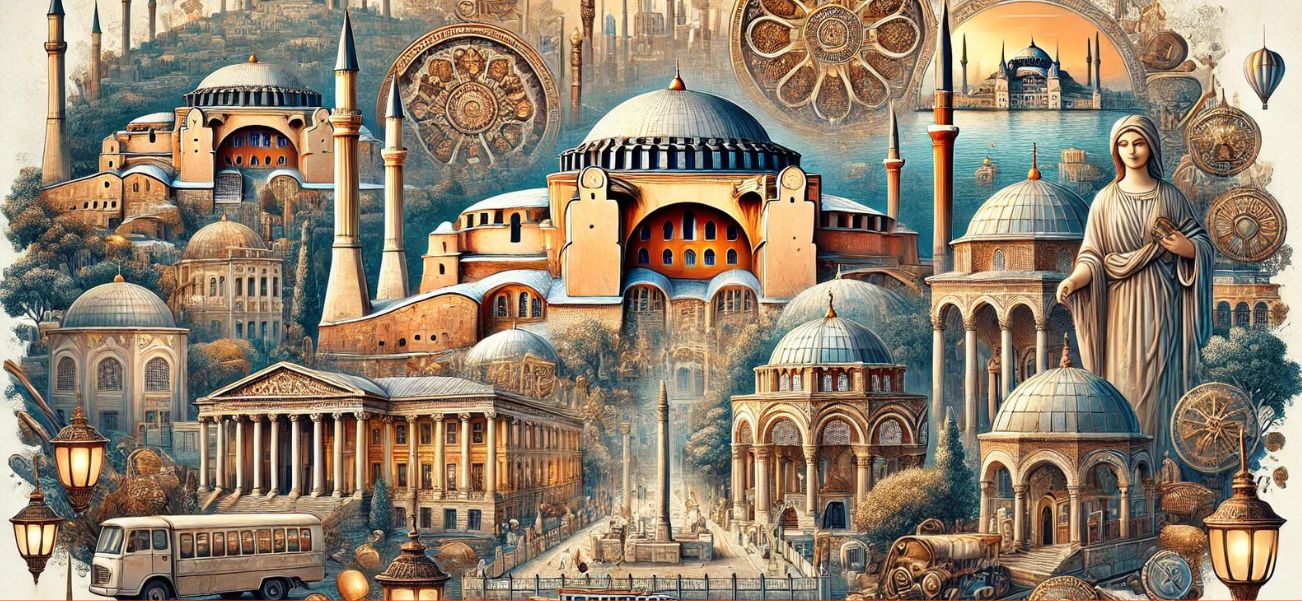
From Byzantion to Istanbul: The Historic Names of Istanbul, World’s Most Layered City
Few cities on Earth possess the profound, name-bearing legacy of the metropolis straddling the Bosporus. Known today as "Istanbul", this is a place where history isn’t just studied; it is etched into the very syllables used to call it home. While many cities have been renamed, Istanbul stands apart as a unique palimpsest, a single urban entity known across millennia and continents by multiple globally recognized names: Byzantion, Constantinople, New Rome, Konstantiniyye, and Istanbul itself.
Each name is far more than a simple label; it is a mirror reflecting seismic shifts in power, religion, culture, and empire. These sequential titles chronicle an astonishing 3,000 years of uninterrupted urban history, from a ancient Greek colony to the nerve center of Roman, Byzantine, and Ottoman empires, and finally to the vibrant heart of modern Turkey.
In this guide, we will journey through time, unpacking the stories behind these iconic names. We will explore why cities change identities, how each name emerged from the ambitions of conquerors and the vernacular of its people, and what this layered nomenclature tells us about one of the world’s most enduring and complex civilizations. Prepare to see Istanbul not just as a destination, but as a living narrative, written and rewritten in the names it has carried.
ISTANBUL: A CITY KNOWN BY MANY NAMES
Listen to the podcast about "Historic Names Of Istanbul":
The Epic History of Turkey: From Ancient Anatolia to Modern Türkiye
I. Why Cities Change Names: Power, Identity & Empire

The naming of a city is never a casual act. It is a fundamental exercise of sovereignty, identity, and memory. Throughout history, renaming has served as a powerful tool for rulers and regimes. At its core, it is a declaration of conquest, a way for a new power to physically and symbolically erase the past and imprint its own authority onto the landscape. It can signal a shift in religion or ideology, as seen when Christian or Islamic names replace pagan ones. It is also a method of rebranding imperial authority, creating a new narrative of continuity or renewal.
Consider Rome, eternally "Roma," its name a testament to its enduring foundational myth. Jerusalem’s names—Yerushalayim, Al-Quds—speak to layers of sacred claim. Alexandria, forever tied to Alexander the Great, marks a moment of Hellenistic conquest frozen in time.

Yet, Istanbul is an exceptional case. Its succession of names does not represent mere replacement but accumulation. Unlike cities where old names are forcibly forgotten, Istanbul’s past identities have persisted in memory, literature, and parallel usage. Each name adds a stratum to its identity, creating a complex whole where Byzantion, Constantinople, and Istanbul coexist in historical consciousness. This resilience makes the city a unparalleled study in how urban identity can absorb transformation without losing its core essence.
Constantine the Great: From Roman Emperor to Founder of Constantinople
II. Byzantion (Byzantium): The Greek Origins

A. Founding of Byzantion (7th century BCE)
The story begins in the mist of legend and the practical needs of Greek expansion. Around 657 BCE (though dates vary), colonists from the Greek city-state of Megara, led by their commander Byzas, sailed into the strategic waters of the Bosporus. According to myth, Byzas had consulted the oracle at Delphi, which told him to settle “opposite the land of the blind.” He found his answer upon seeing the settlement of Chalcedon on the Asian shore, thinking its inhabitants “blind” for overlooking the superior peninsula on the European side. This serpentine-tongued peninsula, with its naturally defensible hills and a deep, sheltered harbor (the Golden Horn), offered a perfect strategic location between Europe and Asia, controlling the vital maritime route between the Black Sea and the Mediterranean.
Ottoman Empire: Successor of the Roman Empire? The Ultimate Historical Debate
B. Meaning of the Name “Byzantion”
The city was named Byzantion (Βυζάντιον) after its legendary founder. Its linguistic roots are likely Greek, though some theories suggest influence from earlier local Thracian place names. To its Greek inhabitants, it was simply “the city of Byzas.” The Latinized form, “Byzantium,” became the standard in later Western historical writing, creating the adjective “Byzantine” that would define an entire empire centuries after the name itself had faded from common use for the city.
C. Byzantion in the Ancient World

For nearly a millennium, Byzantion thrived as a prosperous, though not dominant, Greek city-state. It played a crucial role in Greek trade networks, fishing, and collecting tolls from ships passing through the Bosporus. It forged alliances, minted its own coins (often featuring the city’s symbols: a crescent moon and a star, motifs that would echo through history), and navigated the turbulent politics of the region. It fell under Persian sway, rejoined the Greek world, and eventually became an ally of Rome. Following the Roman conquest of the region, Byzantion was absorbed into the Roman Empire, initially retaining its name and a degree of local autonomy as a provincial city.
D. Why the Name Byzantion Endured
Despite its modest size in the Roman era, the name Byzantion possessed a remarkable durability. It persisted through centuries of Roman rule. More significantly, it was later revived by historians to describe the Eastern Roman Empire that evolved from it. Thus, “Byzantium” transcended its origins as a city name to become the identifier for a 1,000-year civilization, ensuring that the legacy of the humble Greek colony would never be forgotten.
III. Augusta Antonina: The Forgotten Roman Name

History is littered with names that failed to stick, and Istanbul has one such ephemeral chapter. In 196 CE, after a brutal siege against the city for supporting a rival claimant, Emperor Septimius Severus razed Byzantion’s walls. Later, perhaps in an act of reconciliation or dynastic pride, he rebuilt it and renamed it Augusta Antonina, in honor of his son, Marcus Aurelius Antoninus (later known by his nickname, Caracalla).
This name, however, languished in obscurity. It was an imposed, political title lacking organic connection to the city’s people or long history. With political instability following Severus’s dynasty and the lack of deep cultural adoption, “Augusta Antonina” vanished from records and memory almost as quickly as it appeared. It serves as a potent reminder that for a name to endure, it must resonate beyond the decree of a single ruler; it must be embraced by time itself.
IV. New Rome & Constantinople: Capital of an Empire

A. Constantine the Great and the Rebirth of the City
The city’s destiny changed forever in the early 4th century with Emperor Constantine the Great. After consolidating power, he sought a new capital for the Roman Empire—one away from the fraught politics of Rome, closer to the wealthy eastern provinces, and strategically positioned to defend the Danube and Euphrates frontiers. The old Byzantion, with its perfect strategic, economic, and religious geography, was the ideal choice. In 324 CE, he inaugurated a massive construction project, expanding the city walls and filling it with the grandeur befitting an imperial capital.
B. “Nova Roma” (New Rome)
Constantine initially designated the city “Nova Roma” (New Rome). This was a name heavy with ideological weight, asserting continuity with the Roman Empire’s glorious past while launching its future. However, this official name saw limited popular usage. It was a constitutional concept more than a lived identity.
C. Constantinople – “The City of Constantine”

The name that captured the world’s imagination was Constantinopolis (Κωνσταντινούπολις)—"The City of Constantine." It was a personal tribute, but also a powerful symbol of the new Christian-focused empire Constantine was fostering. The name spread rapidly across the Latin, Greek, and Christian worlds, becoming synonymous with imperial power, immense wealth, and theological authority.
D. Constantinople in the Medieval Imagination
For the next thousand years, Constantinople was the most powerful Christian city on Earth. As the center of Orthodox Christianity, it was the guardian of holy relics and home to the Patriarch. Its monumental architecture—the Hagia Sophia, the Great Palace, the Hippodrome—became stuff of legend. It was a bastion of classical learning, a hub of law (the Justinian Code), and a theological powerhouse. To medieval Europeans, it was the ultimate city, a beacon of civilization often viewed with a mix of awe, envy, and rivalry.
E. How “Constantinople” Became a Global Name
The name’s reach was global. Through trade routes, diplomacy, and crusades, "Constantinople" entered languages from English to Arabic (as "Qustantiniyya"). Remarkably, its prestige was so enduring that the name survived centuries after the fall of the Byzantine Empire in 1453, remaining the primary name for the city in Western discourse well into the 20th century.
V. Miklagard, Tsargrad & Other Foreign Names

The city’s majesty was reflected in the names given to it by foreigners. Viking traders and Varangian guards knew it as Miklagard (Old Norse for “The Great City”), a name evoking sheer scale and wonder. To the Slavic peoples, it was Tsargrad (“City of the Caesar/Emperor”), a title that directly acknowledged its imperial status and would later influence Russian imperial aspirations.
In the Arab and Persian worlds, variations like "Qustantiniyya" and later "Istanbul" were used, reflecting both formal and colloquial interactions. These foreign names reveal much about the city’s place in the medieval world: a nexus of global trade routes, a prize in diplomacy and war, and an object of widespread cultural admiration. They show that Constantinople was not just a local capital but a global icon.
VI. Konstantiniyye: The Ottoman Imperial Name

A. The Ottoman Conquest (1453)
When Sultan Mehmed II (Mehmet the Conqueror) took the city in 1453, he faced a critical choice: destroy its legacy or absorb it. He chose the latter, understanding its symbolic power. He presented himself not merely as a destroyer, but as a successor to the Roman Caesars, blending continuity with rupture.
B. “Konstantiniyye” in Ottoman Usage
The Ottomans formalized the Arabic-Ottoman form of the city’s name: (Konstantiniyye). This name was used in official documents, on coins, and in imperial titles (e.g., "Padişah-ı Konstantiniyye" – Emperor of Constantinople). It was the administrative and diplomatic name for the city throughout the Ottoman centuries.
C. Coexistence of Multiple Names

Alongside Konstantiniyye, other poetic names flourished in Ottoman usage:
- İstanbul The common vernacular name (explored next).
- Dersaadet “The Door to Happiness.”
- Asitane “The Threshold,” a Sufi term for a dervish lodge, metaphorically for the imperial capital.
- Darü’s-Saltanat “The Abode of the Sultanate.”
This rich lexicon shows the city’s multifaceted role: an imperial seat, a spiritual center, and a bustling home.
D. Why Ottomans Preserved the Name’s Legacy
By using Konstantiniyye, the Ottomans were claiming Roman imperial heritage. It granted political legitimacy, situating the Ottoman Empire as the rightful heir to a universal imperium. The name connected them to a glorious past they now stewarded, even as they transformed the city with new mosques, bazaars, and a distinctly Ottoman character.
VII. Istanbul: From Colloquial Speech to Official Name

A. Origins of the Name “Istanbul”
The name Istanbul has humble, organic roots. It almost certainly derives from the Greek vernacular phrase “eis tin polin” (εἰς τὴν πόλιν), meaning “to the city” or “into the city.” For centuries, Greeks referring to their capital would simply say they were going “to the City” ("eis tin polin"), as Constantinople was "the" city par excellence. This phrase was adopted by Turkish speakers, evolving phonetically into “İstanbul.”
B. Popular vs. Official Usage
Crucially, “Istanbul” was used in daily life by the city’s multi-ethnic residents long before the Ottoman conquest. For centuries, it existed in a symbiotic relationship with the more formal “Konstantiniyye.” One was for the street, the market, and the home; the other was for the chancery, the court, and the history books.
C. Official Adoption in the 20th Century
The final shift came with the rise of the Turkish Republic under Mustafa Kemal Atatürk. As part of the sweeping modernizing and nationalist reforms, the government officially mandated the use of “İstanbul” in 1930. This was accompanied by an international request for standardization in postal and diplomatic communications. The move was symbolic: shedding an imperial, foreign-sounding name for the authentic, popular Turkish one reflected the Republic’s break with the Ottoman past and its focus on Turkish popular sovereignty. From that point, the name became globally fixed, cementing its place on modern maps.
VIII. Names That Never Fully Disappeared

Despite official decrees, old names possess a ghostly persistence. Constantinople lives on powerfully in the Greek language and diaspora, in religious contexts (the Ecumenical Patriarchate is still “of Constantinople”), and in Western literature and music (from Yeats to “They Might Be Giants”). “Byzantine” remains the essential adjective for the empire’s complex history and intricate artistry. These echoes are not mere nostalgia; they are active layers of the city’s modern identity. They remind us that Istanbul’s history is contested, multifaceted, and still very much alive in the hearts and minds of different communities around the world.
IX. What Istanbul’s Names Tell Us About History

Istanbul’s sequential names are more than historical footnotes; they are a concise guide to the flow of world history. Each name encapsulates a civilization’s claim and contribution. They show us a city claimed by Greeks, Romans, Christians, Muslims, and Turks, not in simple succession but in a complex process of overlay, adaptation, and synthesis. Byzantion speaks to Hellenic exploration; Constantinople to Christian imperial ambition; Konstantiniyye to Islamic universal sovereignty; Istanbul to modern national identity. Together, they present Istanbul as a living archive of world history, a place where the tides of empire, religion, and culture have literally been named into existence.
X. Conclusion: One City, Many Identities

From the legendary Byzas to the emperor Constantine, from the Sultan Mehmed to the modern Republic, the names of Istanbul chart a journey unlike any other. We have traced the city from its origins as Byzantion, through its glorious millennium as Constantinople, its transformative centuries as Konstantiniyye, to its current life as Istanbul. This exploration reveals that no single name can fully define the city. Each is a chapter in an ongoing story.
Istanbul is famously a bridge between continents, but more profoundly, it is a bridge between histories. Its layers are not buried; they are visible in the Theodosian walls beside Ottoman palaces, in the Hagia Sophia’s Christian mosaics beneath Islamic calligraphy. We invite you to see Istanbul as more than a destination: see it as a story in itself—a story told in the many names it has carried, a testament to humanity’s endless capacity to build, conquer, adapt, and endure.
Turkish Language Materials