
Fenerbahçe Basketball in EuroLeague: History, Glory & Legacy
In the vibrant, cross-continental metropolis of Istanbul, where the Bosphorus Bridge connects Europe and Asia, stands a sporting institution that embodies a nation’s ambition. Fenerbahçe Spor Kulübü, founded in 1907, is far more than a football team. It is a multi-sporting empire, a cultural touchstone, and a symbol of identity for millions. Within this empire, Fenerbahçe Basketball has carved its own epic narrative, one centered on a singular, all-consuming quest: conquering Europe.
For decades, the EuroLeague crown represented not just a trophy, but a validation of Turkish basketball on the world’s most prestigious club stage. This journey—from hopeful participants to perennial contenders, through heartbreak and ultimate glory—is a story of relentless investment, transformative leadership, and the unyielding passion of a fanbase that breathes yellow and navy blue. It is a tale of how a club’s European dream became a national mission, reshaping its own identity and leaving an indelible legacy on the continent’s basketball landscape.
FENERBAHCE BASKETBALL EUROLEAGUE JOURNEY & CHAMPIONSHIP STORY
How Fenerbahçe became the Euroleague Champion in 2017:
Rivalries: Two Teams (Anadolu Efes & Fenerbahce) and One City (Istanbul)
Alperen Şengün: The Turkish Basketball Phenom Taking Over the NBA
1. Roots of a Giant: Fenerbahçe Before the EuroLeague Era

The basketball branch of Fenerbahçe was officially founded in 1913, making it one of the oldest in Turkey, yet for most of the 20th century, it lived in the considerable shadow of the club’s footballing might. Success was primarily domestic and often intermittent. The team claimed its first Turkish League title in 1957 and added several more in the 1960s and 70s, but competing in Europe was a different challenge altogether. Early forays into European Cup competitions (the precursor to the EuroLeague) in the 1960s and 70s were brief, often ending in early elimination against the established powers of Italy, Spain, and the Soviet Union.

The infrastructure, budget, and professional focus required for sustained European success were simply not there. While other Turkish clubs like Efes Pilsen (Anadolu Efes) began making more consistent European appearances in the 1990s, Fenerbahçe’s basketball arm operated with a more domestic focus. The comparison was stark: Efes reached the EuroLeague Final Four in 2000, becoming a beacon for Turkish basketball. Fenerbahçe, despite its colossal brand, remained a sleeping giant on the continental stage, its European appearances sporadic and its ambitions unfulfilled. This period established a clear narrative: for Fenerbahçe to be considered a true European giant, matching its football stature, it needed to not just participate in the EuroLeague, but dominate it.
Turkey Women's National Voleyball Team & Players
2. Turkish Basketball’s Rise and Fenerbahçe’s Turning Point

The turn of the millennium saw Turkish basketball undergo a seismic shift. The national team’s silver medal at the 2001 EuroBasket was a watershed moment, showcasing world-class talent like Hidayet “Hedo” Türkoğlu and Mehmet Okur. The domestic Turkish Basketball Super League (BSL) grew in competitiveness and commercial appeal. Television rights, sponsorship money, and the arrival of high-profile American and European players elevated the league’s profile.
For Fenerbahçe’s leadership, particularly under the presidency of Aziz Yıldırım, this was the catalyst. The club made a conscious, strategic decision in the mid-2000s: to pivot its basketball operations towards a singular, elite goal. This was no longer about merely winning Turkish titles; it was about building an organization capable of challenging for the EuroLeague. It meant massive financial investment in a state-of-the-art arena, a world-class training facility (Fenerbahçe Ülker Sports Arena opened in 2012), and, most importantly, in players and coaches of European caliber. This was Fenerbahçe’s declaration of intent—a commitment to transform from a domestic powerhouse into a EuroLeague giant, matching and surpassing the European pedigree of rivals like Efes. The patience was over; the era of ambition had begun.
3. Entering the EuroLeague: Early Appearances and Growing Pains

Fenerbahçe’s re-entry into the EuroLeague spotlight in the late 2000s and early 2010s was a period of building and often painful learning. With coaches like Aydın Örs and Neven Spahija, and stars like Ömer Onan, Emir Preldžić, and Roko Ukić, the team began to qualify regularly. They showed flashes of brilliance—memorable wins, thrilling playoff pushes—but consistency at the highest level proved elusive.
The gap was not just in talent, but in basketball IQ, tactical discipline, and the “killer instinct” required in the tournament’s pressure-cooker moments. Defeats against institutions like CSKA Moscow, FC Barcelona, and Maccabi Tel Aviv were harsh but necessary lessons. They revealed that having a strong roster was not enough; the club needed a winning culture deeply ingrained at every level. These growing pains, however, were critical. They hardened the club’s resolve and clarified what was needed: not just a new coach or a new player, but a complete philosophical overhaul. The foundation of the arena was laid, the budget was committed, and the fans’ expectations were sky-high. All that was missing was the architect.
4. The Obradović Era Begins: A New Mentality (2013–2020)

In the summer of 2013, Fenerbahçe made the signing that would redefine its history: Željko Obradović. The Serbian coaching legend, holder of a record nine EuroLeague titles, was more than a tactician; he was a cultural force. His arrival signaled the club’s ultimate ambition. Obradović instilled a mentality rooted in defensive intensity, meticulous preparation, and an unwavering demand for perfection. Practices became wars. Every detail, from a defensive rotation to a sideline inbound play, was drilled with championship precision.

He immediately began constructing a roster in his image: tough, intelligent, and versatile. The transformation was rapid. Players like Bogdan Bogdanović evolved from promising talents into EuroLeague superstars under his tutelage. The playmaking genius and clutch prowess of Kostas Sloukas became the team’s heartbeat. Jan Veselý was reborn as a dynamic, defensive-minded force. And in the 2016-17 season, the acquisition of Ekpe Udoh provided the defensive anchor—a shot-blocking, switch-capable center who embodied Obradović’s defensive ethos.
The results were spectacular. Fenerbahçe reached the EuroLeague Final Four in 2015, its first in the modern era. They followed it with another in 2016. The team was no longer a hopeful contender; it was a EuroLeague Final Four regular, a legitimate threat every single season. The “EuroLeague giant” status was no longer aspirational; it was a reality. Obradović had built a machine, and it was primed for its ultimate test.
5. Road to Glory: The Historic 2017 EuroLeague Championship

The 2016-17 EuroLeague season was laden with historic weight. The Final Four was to be held in Istanbul, at the Sinan Erdem Dome. The pressure on Fenerbahçe was immense—to win the first EuroLeague title for Turkey, and to do it on home soil.
The season was a masterclass in Obradović’s management. The team finished the regular season with a 21-9 record, showcasing dominance at home and resilience on the road. The playoffs brought a grueling five-game series against Panathinaikos, a classic Obradović vs. his former club battle, which Fenerbahçe won 3-2, showcasing mental fortitude.

In the Istanbul Final Four, destiny called. A tense semi-final against Real Madrid was decided by a single point, 84-83, a victory forged in defensive stops and cool-headed execution. The final against Olympiacos was a tactical masterpiece. Fenerbahçe’s defense, orchestrated by Udoh and Veselý, smothered the Greek side. The offense, led by Bogdanović (17 points) and Sloukas (game-high 18 points), was efficient and controlled. The 80-64 victory was not a fluke; it was a demonstration of total dominance.
The eruption in Istanbul was seismic. The title was historic: the first-ever EuroLeague championship for a Turkish club. It validated a decade of investment, rewarded years of fan loyalty, and crowned Obradović’s project with the ultimate prize. For Turkish basketball, it was a national celebration, proving that the pinnacle of European club basketball was within reach.
6. Sustaining Success: Final Fours, Finals, and Near Misses

The true mark of a European giant is not winning once, but sustaining contention. The Obradović era ensured Fenerbahçe did just that. The very next season, 2017-18, they returned to the EuroLeague Final Four and advanced to the final, only to fall to Real Madrid. In 2019, they were back in the Final Four again. This period was characterized by incredible consistency—five Final Fours in six years (2015-2019).
This sustained excellence came with its own challenges: managing roster turnover, integrating new stars like Luigi Datome and Nicolò Melli, and coping with critical injuries. Financial Fair Play regulations also required careful squad management. Yet, the Fenerbahçe EuroLeague identity was now cemented: a physically tough, defensively elite, and tactically brilliant team that was a nightmare for any opponent in a playoff series. They had moved from chasing glory to defending a standard, a testament to the culture Obradović embedded.
7. Life After Obradović: Transition, Rebuilding, and New Identity

All eras must end. In 2020, after seven historic seasons, Željko Obradović departed. It was the end of a golden chapter and the beginning of a period of uncertain transition. The club navigated through coaching changes—Igor Kokoškov, Šarūnas Jasikevičius, Dimitris Itoudis—each bringing different philosophies.
The challenge was monumental: how to rebuild without the foundational figure of Obradović. The process involved balancing financial sustainability with competitive ambition, integrating promising Turkish talents like Sehmus Hazer and Melih Mahmutoğlu with established stars, and forging a new identity. Under coaches like Itoudis, a fellow EuroLeague champion, the focus remained on high-level tactics, but the shadow of the past loomed large. The modern Fenerbahçe team, while always competitive and featuring stars like Scottie Wilbekin and Johnathan Motley, operates in a new reality—one where the Obradović era is the benchmark, and the quest is to build a new, sustainable legacy of contention in an ever-more-competitive EuroLeague.
8. Ülker Sports Arena: Fortress of Yellow and Navy

A cornerstone of Fenerbahçe’s rise has been the Ülker Sports Arena. In the EuroLeague, home-court advantage is not a luxury; it is a weapon. This 13,800-seat cauldron in Istanbul’s Ataşehir district has become one of the most feared venues in Europe.
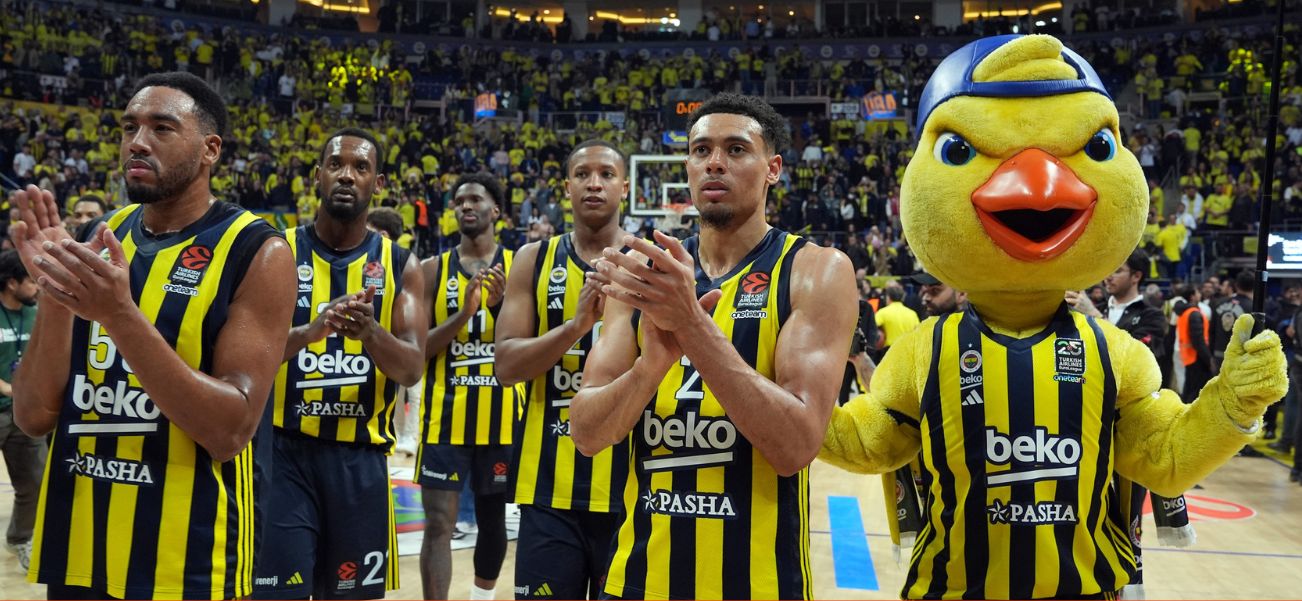
On EuroLeague nights, the arena transforms. The deafening chants of “Fenerbahçe!”, the coordinated displays of yellow and navy, and the palpable intensity from tip-off to final buzzer create an atmosphere that is both intimidating and inspiring. Opposing players often speak of the difficulty of playing there. It is a true fortress, where leads are amplified and deficits are erased with volcanic energy from the stands. This connection between team and fans—the acknowledgment of the fans as the undeniable “sixth man”—has been a critical component in countless crucial victories, especially in the high-stakes playoff games that define a EuroLeague campaign.
9. Rivalries on the European Stage

Fenerbahçe’s ascent forged intense, deeply emotional EuroLeague rivalries:
- Fenerbahçe vs. Olympiacos This is a rivalry of passion and proximity. The battles, particularly in the Obradović era (including the 2015, 2017, and 2023 playoffs), are legendary—physical, tactical, and fiercely contested. The rivalry embodies a clash of two of Europe’s most passionate fanbases.
- Fenerbahçe vs. CSKA Moscow This was a rivalry of ideological clash. In the mid-2010s, it represented the ultimate test: Obradović’s defensive discipline against CSKA’s star-powered, offensive juggernaut led by coaches like Dimitris Itoudis. Their playoff duels were epic chess matches.
- Fenerbahçe vs. Real Madrid This is a rivalry of the elite. Meetings often occur in the highest-stakes environments—Final Fours and Finals (2015 Semi, 2018 Final). It’s a battle between two of the continent’s best-resourced and most ambitious clubs, a clash of brands and basketball philosophies.
These rivalries transcend sport; they are narratives of respect, tactical warfare, and cultural pride, adding layers of drama to the EuroLeague season.
10. Fenerbahçe’s Impact on Turkish Basketball & EuroLeague Legacy

Fenerbahçe’s EuroLeague journey has had a profound impact far beyond its own trophy cabinet:
- Inspiring a Nation Alongside Anadolu Efes’s back-to-back titles (2021, 2022), Fenerbahçe proved Turkish clubs could not just compete, but rule Europe. This has inspired investment across the BSL and raised the aspirations of young Turkish players.
- Raising Turkey’s Profile Turkey is now indisputably a top-tier European basketball nation, thanks in large part to Fenerbahçe’s consistent presence at the summit. It has made Istanbul a mandatory destination for top-tier international talent.
- Blueprint for Management The club’s model—combining deep financial backing with expert basketball leadership (GM Maurizio Gherardini played a key role)—became a template for professional club management in Turkey and beyond.
- Globalizing the EuroLeague Fenerbahçe’s success, driven by its massive, engaged fanbase, helped the EuroLeague solidify its appeal in a critical, basketball-mad market, demonstrating the league’s growth beyond its traditional Mediterranean heartland.
Conclusion: A Story Still Being Written

The story of Fenerbahçe Basketball in the EuroLeague is a modern epic. It is a narrative that moves from longing to fulfillment, from students to masters, built on a foundation of visionary investment, a culture of excellence, and an unbreakable bond with a legendary fanbase. Their legacy is not merely the historic 2017 EuroLeague championship or the string of Final Four appearances; it is the permanent alteration of the European basketball landscape. They showed that with the right mix of ambition, expertise, and heart, new dynasties could be forged.
Today, the story continues. The challenges are different—financial regulations, fierce competition, a new generation of stars—but the core identity remains: Fenerbahçe is a EuroLeague giant. The yellow and navy dream, born on the shores of the Bosphorus, remains fixed on European glory. It is a story of perseverance, identity, and the relentless pursuit of excellence—a story that, like the club itself, is still being written, one epic EuroLeague night at a time.
Turkish Language Materials