

The Blue Mosque, Istanbul: A Complete Guide to History, Architecture, and Visiting Tips
Standing as a timeless silhouette against the Istanbul skyline, the Sultanahmet Mosque, universally known as the Blue Mosque, is more than just a place of worship. It is a symbol of imperial power, a masterpiece of Ottoman architecture, and a living testament to the rich cultural tapestry of a city that straddles two continents. For millions of visitors each year, its grand domes, soaring minarets, and breathtaking interior offer an unforgettable journey into the heart of Islamic art and history.
This in-depth guide will take you through the fascinating history of the Blue Mosque, introduce you to its brilliant architect Sedefkâr Mehmet Ağa, and provide a detailed exploration of its stunning exterior and interior architecture. We will delve into the world of the famous Iznik tiles that give the mosque its nickname, uncover the story behind its unique six minarets, and share some intriguing fun facts. Finally, we’ll provide essential tourism advice and practical tips to ensure your visit is both respectful and rewarding.
BLUE MOSQUE: HISTORY, ARCHITECTURE AND ESSENTIAL TIPS
Listen to the podcast about "The Blue Mosque":
RECOMMENDED READING The Ultimate Istanbul Travel Guide: Discover The Soul Of Two Continents
A Sultan's Vision: The History of the Blue Mosque

To understand the Blue Mosque, one must first understand the context of its creation. The early 17th century was a critical period for the Ottoman Empire. Following a prolonged war with Persia and a series of military setbacks, the empire's prestige was in need of a boost. The young Sultan Ahmed I, who ascended to the throne at the age of 13, sought to reaffirm Ottoman power and his own piety through a grand architectural statement.
15 Most Beautiful Mosques in Istanbul
Unlike many of his predecessors who built monumental mosques using spoils of war, Ahmed I financed the construction entirely from the state treasury, as he had no significant military victories to his name. This act was both a demonstration of the empire's enduring wealth and a personal act of religious devotion.

Construction began in 1609 on the site of the ancient Great Palace of the Byzantine Emperors, right opposite the Hagia Sophia—the former basilica and architectural marvel that had dominated the skyline for over a thousand years. The location was deliberately chosen; the Sultan aimed to rival, and even surpass, the glory of the Hagia Sophia. The project was a massive undertaking, involving thousands of workers and artisans, and was completed in just seven years, opening for worship in 1616.
Grand Bazaar Istanbul: A 550-Year-Old Shopping Mall & Cultural Heart Of Istanbul
The mosque was part of a larger "külliye"—a complex of buildings dedicated to serving the community. This original complex included a madrasa (theological school), a hamam (public bath), a hospital, a soup kitchen, and a caravanserai. While many of these ancillary buildings remain, the mosque itself is the undisputed centerpiece.
The Master Behind the Masterpiece: Architect Sedefkâr Mehmet Ağa

The monumental task of bringing the Sultan's vision to life fell upon Sedefkâr Mehmet Ağa. His name itself offers a clue to his expertise; "Sedefkâr" means "mother-of-pearl inlayer." He was not just an architect but a master craftsman in the royal guild. More importantly, he was a student of the greatest architect in Ottoman history: Mimar Sinan.

Sinan, the chief court architect for half a century, had perfected the classical Ottoman style, and Mehmet Ağa absorbed his principles. The Blue Mosque is considered the magnificent culmination of the classical period, a synthesis of Sinan’s ideas pushed to their most refined and elegant expression. Mehmet Ağa took the architectural vocabulary of his master—the central dome, the semi-domes, the spacious courtyard—and composed a structure of perfect harmony and proportion. His background in decorative arts is evident in the mosque's exquisite interior detailing, where architecture and ornamentation become one.
20 Essential Istanbul Travel Apps For Your Vacation
A Study in Grandeur: The Exterior Architecture
The exterior of the Blue Mosque is a powerful and imposing sight, designed to evoke a sense of awe even before one steps inside.
The Cascading Domes

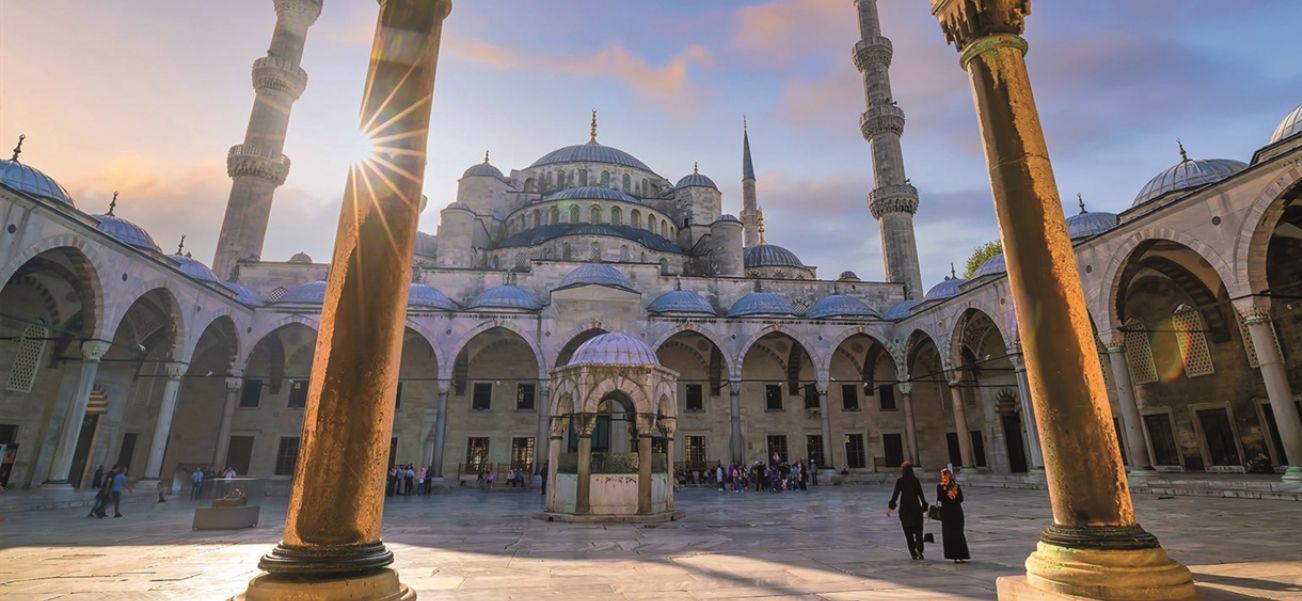
The mosque's profile is defined by a majestic cascade of domes. The central dome, with a diameter of 23.5 meters and a height of 43 meters, rests on four massive, elephantine piers known as "elephant feet." It is flanked by four smaller semi-domes, which in turn are supported by even smaller semi-domes. This pyramidal succession creates a sense of rhythmic progression, leading the eye upward to the heavens while ensuring structural stability by distributing the immense weight.
The Six Minarets

Perhaps the most distinctive feature of the exterior is its six minarets. This was a highly controversial and audacious choice at the time. Until then, the only mosque in the world with six minarets was the Masjid al-Haram in Mecca, the holiest site in Islam. The decision sparked outrage, with critics accusing the Sultan of arrogance. Legend has it that Sultan Ahmed resolved the issue by funding the construction of a seventh minaret at the Mecca mosque, thereby re-establishing its supremacy. The minarets are fluted and feature multiple balconies (şerefe), from which the muezzin calls the faithful to prayer.
The Courtyard (Avlu)

The mosque is preceded by a massive rectangular courtyard, one of the largest of all Ottoman mosques. Surrounded by a colonnaded arcade with 30 small domes, the courtyard features a central hexagonal şadırvan (ablution fountain), where worshippers perform ritual washing before prayer. The monumental entrance gate on the north side sets the stage for the grandeur that lies within.
Discover Istanbul beyond Sultanahmet
An Interior Paradise: Where Light Meets Iznik Tiles
If the exterior commands respect, the interior inspires sheer wonder. Stepping inside the Blue Mosque is a transformative experience, a feeling of entering a serene, celestial space.
The "Blue" Wonder: Iznik Tiles

The mosque’s popular name, the Blue Mosque, is derived from the thousands of magnificent hand-painted Iznik tiles that adorn its interior walls. Iznik, a town in northwestern Turkey, was the epicenter of high-quality ceramic production in the 16th and 17th centuries. The tiles in the Blue Mosque represent the peak of Iznik craftsmanship.

These are not just decorative elements; they are a complex artistic program. Featuring over 50 different tulip designs, as well as cypresses, roses, carnations, and intricate geometric patterns, the tiles create a garden-like atmosphere, reflecting the Islamic concept of paradise. The dominant color is a brilliant cobalt blue, but the palette also includes vibrant turquoise, green, and the coveted, difficult-to-produce Iznik red.

The tiles are placed strategically. The lower levels are covered entirely in tiles, while the upper levels feature painted decoration. The galleries are particularly rich in tiled panels, with the imperial loge displaying some of the finest examples. It’s estimated that over 20,000 tiles were used in the mosque's decoration, making it one of the most extensive collections in the world.
The Play of Light

The interior is intentionally dimly lit, with light filtering in through 260 stained-glass windows. These were a gift from the Signoria of Venice to the Ottoman Sultan and were crafted by the master glazier Sarhoş Ibrahim. The modern windows are replicas, but they effectively recreate the original effect. The light illuminates the tiles, making the colors shift and glow throughout the day, creating an ever-changing, ethereal ambiance.
Calligraphy and Other Elements

The interior is further embellished with superb examples of Ottoman calligraphy. Verses from the Quran, written by the celebrated calligrapher Seyyid Kasim Gubari of Diyarbakır, adorn the domes, semi-domes, and piers. The most prominent feature is the large medallion hanging from the main dome, inscribed with the Shahada (the Islamic declaration of faith). The mihrab (prayer niche indicating the direction of Mecca) is carved from a single piece of marble and is flanked by intricately lit candles. The nearby minbar (pulpit) is a masterpiece of marble craftsmanship, showcasing the skill of Ottoman stone carvers.
The Story of the Six Minarets: More Than Just a Number
The six minarets of the Blue Mosque deserve a deeper look, as their story is central to its legend. As mentioned, this feature caused a major controversy. In the 17th century, architectural symbolism was deeply intertwined with religious and political authority. A mosque’s size and features were direct reflections of the Sultan’s power and piety.
By building a mosque with six minarets, Ahmed I was making a bold statement. He was positioning himself and his empire as central pillars of the Islamic world. The ensuing scandal was so significant that it entered popular folklore. The most common tale is that the Sultan, upon realizing his error, ordered a seventh minaret to be built at the Great Mosque of Mecca to placate the critics. While this makes for a great story, historical records show that the Kaaba already had seven minarets by this time. The controversy, however, was very real and highlights the immense symbolic weight carried by Ottoman architecture. Today, the six minarets remain the mosque's most iconic and unique external feature, creating a stunning symmetrical silhouette.
Fun Facts: Uncovering the Quirks and Secrets

Beyond the grand history and architecture, the Blue Mosque holds many fascinating details:
- Chain of Justice A heavy iron chain hung in the courtyard entrance, low enough that the Sultan had to lower his head when entering on horseback. This was a symbolic gesture, reminding him that he was humble before God and justice.
- The "Batman" Connection The famous scene in the 2012 film "The Batman" where Bruce Wayne emerges from a prison in a deep well was filmed in a cavernous, now-closed cistern located beneath the mosque's courtyard.
- A Working Mosque Unlike the Hagia Sophia, which is a museum, the Blue Mosque is a fully functioning mosque. All visitors are welcome outside of the five daily prayer times, allowing you to experience it as a living center of faith.
- Pigeon-Deterrent Soap The mosque's lead architect, Sedefkâr Mehmet Ağa, reportedly mixed crushed ostrich eggs into the mortar used for the exterior. The belief was that the smell would deter spiders and pigeons from nesting—a primitive but ingenious form of pest control.
- The Missing Complex Much of the original külliye, including the madrasa, hammam, and hospital, has been repurposed or integrated into the modern urban fabric, but their existence reminds us of the mosque's original role as a social hub.
The Blue Mosque Today: Tourism and Reverence

Today, the Blue Mosque is one of the most visited tourist attractions in Istanbul, drawing millions of visitors from all faiths and cultures. It stands in the heart of the Sultanahmet district, a UNESCO World Heritage Site, forming an unparalleled historical duo with the Hagia Sophia.
This high volume of tourism is carefully managed to balance the needs of visitors with the mosque's primary function as a place of worship. It is closed to non-worshippers for approximately 90 minutes during each of the five daily prayer times, and all day on Friday mornings for special congregational prayers.
The coexistence of tourism and active worship creates a unique atmosphere. It is a place where the click of cameras mingles with the quiet murmur of prayers, and where visitors from around the world can witness the deep spirituality that continues to animate this 400-year-old monument.
Essential Tips for Your Visit

To make the most of your visit and ensure you are respectful of the sacred space, here are some crucial tips:
- Check Prayer Times Before you go, check the daily prayer times online. Plan your visit for the windows between these times to avoid disappointment.
- Dress Modestly This is mandatory for both men and women. Clothing should cover shoulders and knees. Women are required to cover their heads with a scarf. If you forget, scarves and cover-up garments are available at the entrance for free (though a donation is appreciated).
- Remove Your Shoes You will be required to remove your shoes before entering the carpeted prayer area. Plastic bags are provided to carry your shoes with you.
- Observe Silence Speak quietly and avoid making loud noises. This is a place of reflection and worship for many.
- Be Mindful of Photography Flash photography is prohibited as it can damage the ancient tiles and artworks. Be discreet when taking pictures of people at prayer.
- Respect the Barriers Do not cross the ropes or barriers meant to cordon off areas for worshippers.
- Visit Early or Late To avoid the largest crowds, aim for an early morning visit right after it opens to the public, or later in the afternoon.
- Look Up Don't forget to admire the central dome, the calligraphy, and the stained-glass windows. The beauty of the mosque is in its verticality and the harmony of its entire space.
- Explore the Exterior Take time to walk around the outside, appreciate the courtyard, and view the mosque from the nearby Hippodrome or Sultanahmet Square for the best photographic opportunities.
Conclusion: An Enduring Legacy

The Blue Mosque is more than just a collection of stones, tiles, and minarets. It is the physical manifestation of an empire's confidence, an architect's genius, and a sultan's faith. It represents the zenith of classical Ottoman architecture and continues to be a vital, beating heart of Istanbul. From its controversial six minarets to the serene beauty of its Iznik tile-lined interior, every detail tells a story.
Whether you are a history buff, an architecture enthusiast, or a spiritual seeker, a visit to the Blue Mosque is an essential Istanbul experience. It is a place that demands not just to be seen, but to be felt—a timeless sanctuary where the past and present gracefully intertwine under the soft, colored light of its storied windows.
Turkish Language Materials