
From Forbidden Brew to Cultural Icon: The History of Turkish Coffee in the Ottoman Empire
Close your eyes and let the cobblestone streets of old Istanbul rise around you. The year is 1570. The air is thick with the briny breeze of the Bosphorus and the sweet, smoky perfume of roasting beans. From a low stool in a lantern-lit corner, you hear it: the gentle *thump* of a brass "cezve" (coffee pot) being set into hot ash. The liquid inside hisses, swells with a crown of fine foam, and is poured into a "fincan" (coffee cup) no larger than an egg. This is not just a morning pick-me-up. This is the history of coffee in the Ottoman Empire.
For most of the world, coffee is a commodity. For the Ottomans, it became a ritual, a political act, and a cultural identity. Long before the espresso machine or the French press, there was Turkish coffee history—a story of mystics, merchants, sultans, and poets who transformed a simple bean into a cornerstone of civilization.
Although the coffee plant originated in the highlands of Ethiopia and was first cultivated in Yemen, it was within the sprawling borders of the Ottoman Empire that the beverage matured into a global phenomenon. From the grand bazaars of Constantinople to the siege lines outside Vienna, this dark brew fueled empires and sparked revolutions. The thesis is simple yet profound: Ottoman coffee culture fundamentally reshaped social life, etiquette, and global habits in ways that still linger in every sip you take today.
STORY OF TURKISH COFFEE IN THE OTTOMAN EMPIRE
Listen to this podcast about the history of Turkish coffee in the Ottoman Empire:
Turkish Coffee 101: A Beginner's Guide to This Timeless Tradition
1. The Origins of Coffee: From Ethiopia to Yemen
To understand the Turkish coffee origin, we must first travel 1,500 miles south to the misty plateaus of Ethiopia. Legend tells of a goat herder named Kaldi, who noticed his flock behaving strangely. After nibbling on red berries from an unknown shrub, the goats refused to sleep. They danced through the night with electric energy. Curious, Kaldi chewed the berries himself and soon felt a strange vitality. A local monk, seeing this, threw the berries into a fire—producing the first aromatic roast.
While Kaldi’s story is likely apocryphal, the reality is no less mystical. By the 15th century, the Sufi monasteries of Yemen had discovered that a boiled drink made from the flesh of the coffee cherry (rather than the bean) could induce a state of spiritual wakefulness. For the Sufis, coffee was not a vice but a tool. It allowed them to perform "dhikr" (the remembrance of God) for hours without succumbing to sleep. These early preparation methods were crude—often just dried hulls boiled in water—but they set the stage for a global obsession.
In Yemen, coffee became a spiritual and social beverage. It was shared after prayers, used to seal business deals, and drunk to enhance conversation. The port of Mocha became synonymous with the brew. But the bean was restless. It was about to travel north along the sacred routes of the Hajj, heading straight for the heart of a rising empire.
Key Transition: Coffee’s journey from the spiritual highs of Yemen to the political labyrinths of the Ottoman Empire was inevitable.
Turkish Coffee: A Journey Through History and Flavor
2. Arrival of Coffee in the Ottoman Empire
The history of coffee in the Ottoman Empire begins in earnest in the early 16th century. As Ottoman forces extended their control over the Hejaz (modern-day Saudi Arabia) and Egypt, they controlled the primary trade and pilgrimage routes. Pilgrims returning from Mecca and Medina would pass through Cairo, carrying sacks of “qahwa” as a souvenir of their holy journey.
Coffee entered Istanbul via two distinct routes: the trade routes of the Red Sea and the pilgrimage routes of the Levant. Merchants from Aleppo and Damascus set up the first rudimentary coffee stalls near the docks. By the 1540s, a quiet revolution was brewing.
The first official introduction of coffee to the Ottoman capital is credited to two Syrians: Hakem of Aleppo and Shams of Damascus. They opened small shops in the Tahtakale district around 1554. Tahtakale was the industrial heart of the city—a maze of warehouses, spice sellers, and textile dyers. It was here that the first coffeehouses in history appeared.
Why did Istanbul become the center of coffee culture?
Geography and law. The city was the crossroads of three continents. It had the wealth to support luxury goods and, initially, a legal system that viewed coffee as a medicine. Ottoman scholars debated the legality of the brew. Was it intoxicating? Was it forbidden like wine? They eventually ruled it "halal", paving the way for a cultural explosion.
Cultural Importance of Turkish Coffee: Beyond the Cup
3. Birth of Turkish Coffee: Technique and Identity
What makes coffee “Turkish”?
It is not the bean. Turkey does not grow coffee. The magic lies in the technique and identity. Turkish coffee history diverges from all other brewing methods in one critical way: the grind.
Ottoman brewers realized that if you ground the bean into a powder finer than flour—so fine it feels like baby powder between your fingers—it would sink to the bottom of the cup rather than float. This allowed them to brew without filtration. The cezve (a small, long-handled brass or copper pot) was born. The brewing process is a meditation. Cold water and sugar (if desired) are added to the cezve. The coffee is sprinkled on top. Never stir. The pot is placed over low heat. As the liquid warms, a thick, caramel-colored foam rises. This foam is the sign of mastery. A true Ottoman barista pours the foam into each fincan first, then returns the pot to the heat to bring the liquid to a boil.
The serving style is as ritualized as the brewing. A glass of water is served first to cleanse the palate. A small piece of Turkish delight (lokum) accompanies the coffee to counteract the bitterness. The phrase “A cup of coffee is remembered for 40 years” (Bir fincan kahvenin kırk yıl hatırı vardır) entered the lexicon. It meant that when you shared coffee with someone, you were bound to them in friendship and honor for decades.
Key Insight: Turkish coffee is not about the bean, but the method and culture. It turned a simple beverage into a symbol of refinement and daily necessity.
Why Turkish Coffee Is the Ultimate Drink for Coffee Lovers
4. Coffeehouses: The Social Revolution
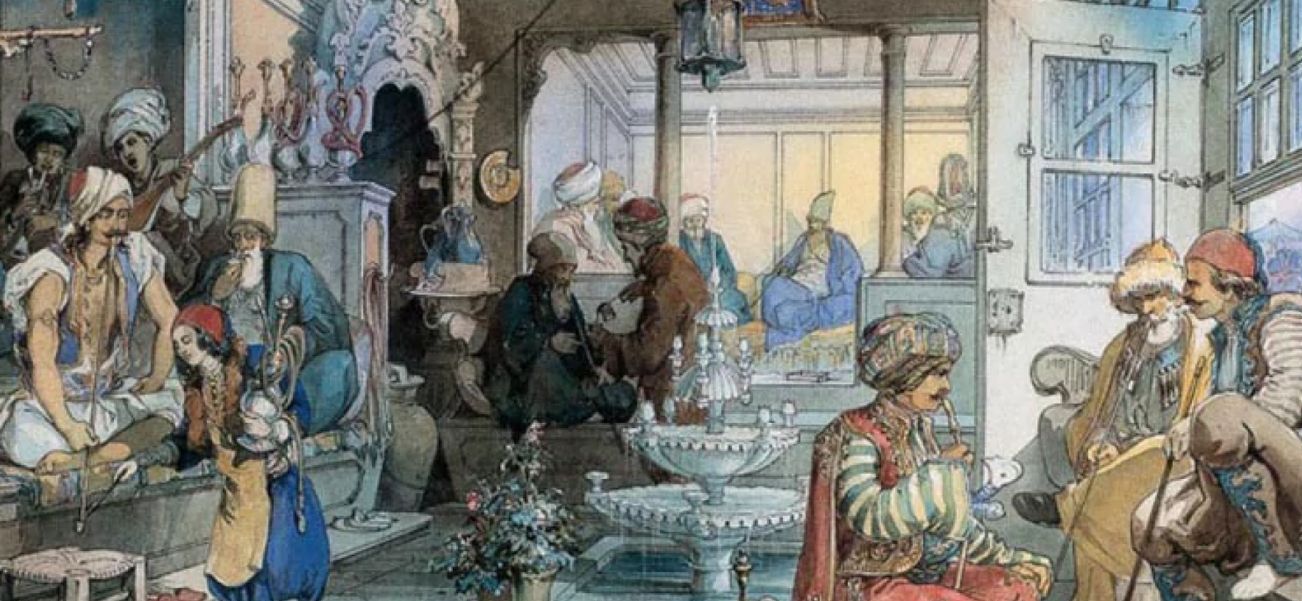
The explosion of kahvehane (coffeehouses) in the 16th century was the Ottoman Empire’s social revolution. Before coffee, the average subject lived between two places: the home (private) and the mosque (sacred). There was no secular “third place.” Coffeehouses changed that.
These spaces were not cafes in the European sense. They were loud, smoky, and chaotic. Who gathered there? Everyone. The Janissaries (elite soldiers) used them as unofficial barracks. Intellectuals and poets debated the nature of the universe. Scholars held informal lectures. Even the common people came to listen, gossip, and escape the cold.
The activities inside a coffeehouse defined Ottoman leisure. Men played backgammon (tavla) and chess for hours. Storytellers, known as "meddahs", performed dramatic tales from Persian epics. Shadow puppets (Karagöz and Hacivat) mocked the authorities. And always, there was the low hum of political discussions.
Historians argue that coffeehouses represented the first public spaces in Ottoman society. They democratized conversation. A cobbler could sit next to a vizier if they both had a few coins for a cup. This was the early form of social media—a network of information exchange that bypassed the palace.
The atmosphere was intoxicating: the smoke from water pipes (nargile) curling to the ceiling, the clack of tavla pieces, the hiss of the cezve, and the shout of the waiter. It was here that Ottoman social life was truly forged.
How Turkish Coffee Became a UNESCO Cultural Heritage
5. Controversy and Bans: Coffee as a Threat
Of course, such freedom could not last. The rise of the coffeehouse terrified the elite. To the religious authorities, coffee was a stimulant that replaced wine as a source of reckless abandon. To the political leaders, the coffeehouse was a breeding ground for sedition.
Opposition came from two fronts. Sheik-ul-Islams (the highest religious authority) issued fatwas declaring coffee "haram" if it caused insomnia or wasted time. But the real fury came from the throne.
Sultan Murad IV (reigned 1623–1640) is the most infamous figure in Turkish coffee history. He was a paranoid, iron-fisted ruler who banned coffee, tobacco, and alcohol outright. He patrolled the streets of Istanbul disguised as a commoner. If he found a coffeehouse open, he would execute the owner on the spot—sometimes with his own hands. Coffeehouses were closed or destroyed. The sultan feared that conversation led to conspiracy. He remembered the Janissary revolts; he knew that plotters met over coffee.
Why were they so afraid? The fear of rebellion.
In a pre-telegraph era, the coffeehouse was the only place where rebels could coordinate. A man drinking coffee was a man thinking. A man thinking was a threat.
Outcome: Despite the bans, the executions, and the moral panic, coffee survives and becomes stronger. By the end of Murad IV’s reign, the bans were quietly lifted. The people had won. Coffee was now inseparable from Ottoman identity.
How to Make Authentic Turkish Coffee: Mastering the Brew
6. Coffee and Daily Ottoman Life
Beyond the politics, coffee seeped into every crack of domestic existence. Role in hospitality became codified. If a guest arrived, they were offered coffee first—before food, before water. To refuse was an insult. To accept was a bond.
Perhaps the most charming element of Ottoman coffee culture is the marriage traditions. When a potential groom arrived at a bride’s house to ask for her hand, the bride would prepare the coffee. She would add salt instead of sugar to the groom’s cup. If he drank it without complaint, he was patient. If he frowned, he was hot-headed. Today, the “salty coffee” ritual remains a beloved (and dreaded) part of Turkish weddings.
Gender roles in coffee consumption were distinct. Public coffeehouses were almost exclusively male. However, inside the harems and homes, women had their own coffee rituals. They would grind the beans while gossiping, read fortunes from the grounds left in the cup ("fal"), and host afternoon gatherings. Coffee became a daily necessity—a line item in household budgets alongside bread and oil. It was a symbol of respect. To serve weak coffee was to insult a guest. To serve strong, dark coffee was to honor them.
7. The Global Journey: From Istanbul to Europe
The history of how coffee spread to Europe is written in Ottoman footsteps. For 150 years, the Ottomans guarded the secret of the fertile bean. They banned the export of viable green beans. But ideas, like coffee foam, always rise.
How did coffee spread? Through diplomats, traders, and Ottoman-European contact.
Venetian merchants who had tasted coffee in Constantinople brought the idea home. By 1645, the first coffeehouse opened in Venice. But the most famous story—the one that turned coffee into a global commodity—occurred during the siege of Vienna in 1683.
As the Ottoman army retreated, they abandoned hundreds of sacks of green coffee beans. A Polish spy named Jerzy Franciszek Kulczycki recognized the beans. He had lived in Istanbul and knew the brewing method. He opened the first coffeehouse in Vienna, called “The Blue Bottle.” To make the bitter Ottoman brew palatable to Viennese taste buds, he filtered out the grounds and added milk and sugar.
Key cities followed: Paris in 1689 (Café Procope), London (Pasqua Rosée’s shop). Europe reshaped coffee into espresso, cappuccino, and the French press. But the soul of the beverage—the ritual, the social space, the intellectual energy—was purely Ottoman.
Insight: Europe reshaped coffee, but Ottomans defined its culture. Without the first coffeehouses Istanbul, there would be no Starbucks, no café culture, no office coffee machine.
8. Legacy: Turkish Coffee Today
Step into any modern home in Istanbul, Ankara, or Izmir, and the ritual is unchanged. Turkish coffee today is still central in Turkey, the Balkans, the Middle East, and the Caucasus. It is a ghost that haunts every modern café.
In 2013, UNESCO recognized this power. Turkish coffee was inscribed on the Representative List of the Intangible Cultural Heritage of Humanity. UNESCO noted that it is not just a drink but “a symbol of hospitality, friendship, and refinement.”
The modern role of Turkish coffee is twofold: tradition and tourism. In the Grand Bazaar, you can still watch a "kahveci" (coffee maker) roast beans over a gas flame, grinding them to powder in a brass mill. Tourists line up for coffee fortune telling (fal). After drinking, they invert the cup onto the saucer. When the grounds cool, patterns form. A skilled reader (often a grandmother) interprets the shapes—a bird means good news, a snake means an enemy.
Reflection: This is a drink that carries centuries of history in a single sip. When you drink Turkish coffee, you are tasting the Sufi monasteries of Yemen, the brass cezves of the Janissaries, the wrath of Sultan Murad IV, and the poetry of Rumi.
9. Conclusion: More Than Coffee
We began with a sensory scene in a 16th-century Istanbul coffeehouse. We end in the present, holding a small porcelain cup flecked with black mud at the bottom. The journey of coffee is the journey of modernity itself.
From the legendary goat herder Kaldi in Ethiopia to the mystical Sufis of Yemen; from the trade routes that fed Ottoman coffee culture to the forbidden coffeehouses that defied a sultan; from the siege of Vienna to the UNESCO heritage list—this is a story of resistance, ritual, and connection.
Turkish coffee history is not merely about caffeine. It is about the human need for a third place, a reason to linger, a vessel for conversation. The Ottoman Empire is long gone, but every time you hear the hiss of a cezve, you are listening to an echo of a civilization.
So the next time you lift a fincan to your lips, pause. Look at the foam. Smell the smoke. Remember the 40 years of friendship. And take a sip of history.
Afiyet olsun. (May it bring you health.)
Turkish Language Materials