


The Tulip Era of the Ottoman Empire: Luxury, Reform, and the Birth of Modern Istanbul
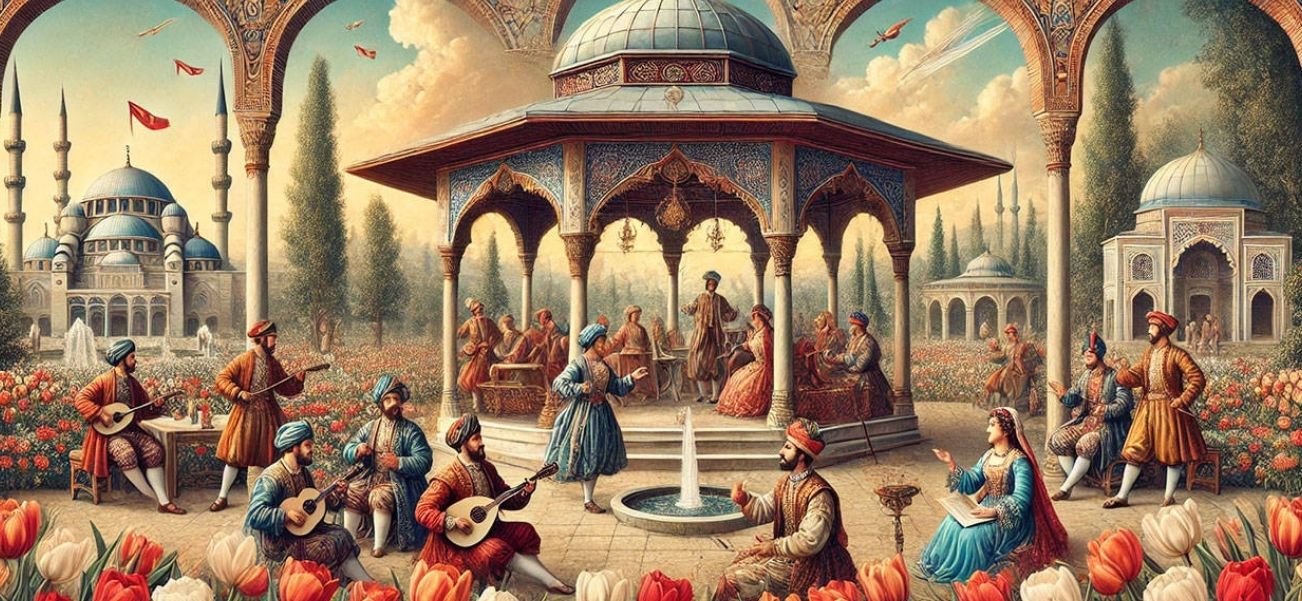
Imagine an Istanbul spring night in the early 1720s. As dusk settles over the Golden Horn, thousands of lamps and candles are lit, not to illuminate the streets, but to showcase a garden’s true protagonists: tens of thousands of tulips in full, glorious bloom. Their petals, reflecting the flickering light, display a dizzying array of colors and shapes—flamed, feathered, elongated, and cupped. Fountains murmur in the background, their waters catching the light. In open-air kiosks, the empire’s elite recline on silk cushions, listening to poets recite verses that compare a beloved’s cheek to a tulip’s curve. This is not a scene from a fable but a regular occurrence during the *Lâle Devri*—the Tulip Era—a brief, glittering, and profoundly transformative period in Ottoman history.
Spanning from 1718 to 1730, the Tulip Era represents a fascinating paradox: a time of remarkable cultural flourishing, architectural innovation, and openness to European ideas that ended in a bloody popular revolt. It was an age when a flower became an imperial obsession, symbolizing not only wealth and refinement but also a conscious pivot away from the empire’s martial past toward a new vision of cosmopolitan modernity. For historians and travelers alike, this era captivates because it feels like a moment of suspended animation between a fading classical order and an emerging modern world, full of both promise and peril.
This guide will explore the lush landscape of the Tulip Era, examining its origins, key figures, and enduring legacy. We will delve into the unprecedented luxury and courtly life that defined the period, embodied by Sultan Ahmed III and his powerful Grand Vizier, Nevşehirli Damat İbrahim Pasha. We will trace the deliberate policies of reform and Westernization that introduced the printing press, reshaped diplomacy, and reimagined Istanbul’s urban fabric. Finally, we will confront the deep social tensions that simmered beneath the surface of this elegant society, tensions that ultimately erupted in the violent Patrona Halil Rebellion of 1730. Our thesis is that the Tulip Era, far from being a mere interlude of decadence, was a crucial turning point—a bold, if flawed, experiment in redefining Ottoman identity that left an indelible mark on the culture, aesthetics, and trajectory of what would become modern Turkey.
THE TULIP ERA OF THE OTTOMAN EMPIRE: WHEN THE TULIPS RULED AN EMPIRE
Listen to the podcast about the "Tulip Era Of The Ottoman Empire":
From Byzantion to Istanbul: The Historic Names of Istanbul, World’s Most Layered City
1. What Was the Tulip Era? Historical Context
The Tulip Era ("Lâle Devri" in Turkish) is a term coined by later historians to describe the period of Ottoman history from the Treaty of Passarowitz in 1718 to the Patrona Halil Rebellion in 1730. This timeframe corresponds roughly to the vizierate of Nevşehirli Damat İbrahim Pasha during the reign of Sultan Ahmed III (1703–1730). The era’s name is derived from the iconic flower that became an all-consuming passion for the Ottoman elite, but its significance runs much deeper than horticultural fashion.
The era was born from a moment of geopolitical recalibration. The Treaty of Passarowitz (1718) concluded a disastrous war with the Habsburg Empire, resulting in significant territorial losses for the Ottomans in the Balkans. This military defeat, however, ushered in a prolonged period of peace on the empire’s western frontiers. For a state long defined by almost constant military expansion, this peace created both a crisis of identity and an unprecedented opportunity. The imperial court, freed from the immediate pressures of large-scale war, turned its energies inward toward cultural projects, pleasure, and administrative reform.
Ottoman Empire: Successor of the Roman Empire? The Ultimate Historical Debate
The tulip was not a new import; it had been cultivated in Ottoman gardens since the 16th century, originally from Central Asia. However, during this period, it ascended from a beloved garden flower to a full-blown cultural phenomenon and status symbol. The era’s ethos can be compared to European cultural periods like the Baroque and Rococo, which also emphasized ornamentation, leisure, and a celebration of sensory pleasure. Like the Sun King’s Versailles, the Ottoman court under Ahmed III became a theater of spectacle and refined taste.
Critically, the Tulip Era was more than a political phase; it was a cultural mindset. It represented a conscious embrace of "zevk ü sefa" (pleasure and delight) as governing principles for elite life. This was a dramatic shift from the austere, warrior-prince ideal of earlier sultans. The period was characterized by an explosion in poetry, music, architecture, and garden design, all centered on creating and appreciating beauty. It was a time when the Ottoman elite attempted to construct a new kind of imperial grandeur—one based on cultural sophistication and worldly enjoyment rather than solely on military conquest.
2. Sultan Ahmed III: The Patron of Elegance
At the heart of this cultural renaissance was Sultan Ahmed III, a ruler whose personality and tastes indelibly shaped the era. Unlike his immediate predecessors, who had been deposed or struggled with military crises, Ahmed III came to the throne in 1703 and, after the peace of 1718, found the space to cultivate his vision of a refined empire.
The Secrets of the Ottoman Harem: A World of Power, Passion, and Palace Intrigue
Ahmed III was a true patron of the arts. He was an accomplished calligrapher and poet himself, writing under the pen name "Âşık" (The Lover). His court attracted the greatest literary and artistic minds of the day, including the famous poet "Nedim", whose playful, lyrical verses became the anthem of the Tulip Era. The Sultan’s leadership style was less that of a field commander and more that of a cultivated aesthete and orchestrator of courtly life. He was deeply involved in the planning of festivals, garden parties ("helva sohbetleri"), and architectural projects, micromanaging details to ensure they met his exacting standards of elegance.
His vision was to transform the Ottoman Empire, and particularly its capital, into a beacon of civilization and luxury that could rival the courts of Europe. He saw cultural patronage as a source of imperial prestige. This represented a significant departure from the model of earlier warrior sultans like Mehmed the Conqueror or Suleiman the Magnificent, whose legacies were built on law and conquest. Ahmed III’s reign signaled that imperial power could also be expressed through the control of taste, the sponsorship of beauty, and the creation of a dazzling courtly milieu.
His relationship with artists and intellectuals was direct and personal. He provided them with stipends, patronage, and a receptive audience, fostering an environment where artistic innovation was encouraged. This close partnership between the sovereign and the cultural elite was fundamental to the flourishing of the Tulip Era’s distinctive aesthetic, making Ahmed III not just a ruler but the chief curator of a new Ottoman sensibility.
Osman Hamdi Bey: Ottoman Artist, Archaeologist & Founder of Istanbul Archaeological Museums
3. Grand Vizier Nevşehirli Damat İbrahim Pasha: Architect of the Era
If Sultan Ahmed III was the visionary patron, his Grand Vizier, Nevşehirli Damat İbrahim Pasha, was the indefatigable architect and engineer of the Tulip Era. Born in the town of Nevşehir, he married the Sultan’s daughter, earning the title "Damat" (bridegroom), and rose to the grand vizierate in 1718. His partnership with Ahmed III was one of the most consequential in late Ottoman history.
İbrahim Pasha was a complex figure: a shrewd statesman, a reformer with a curiosity about the world, and a lover of luxury whose ambitions would eventually make him a target. His reformist mindset was pragmatic. The peace following Passarowitz presented an opportunity to stabilize the empire internally. He focused on diplomacy, cultivating peaceful relations with European powers, and initiated a series of projects aimed at modernizing the state and beautifying the capital.
His role in urban development was transformative. He oversaw the construction of monumental public fountains ("sebils") and libraries, and most famously, he masterminded the creation of the Sadabad Palace and the Kağıthane gardens. Located along the Golden Horn, this vast recreational complex—with its canals, cascades, and pavilions—was designed as a paradise on earth and became the primary stage for the court’s extravagant tulip festivals. It was Istanbul’s answer to Versailles, a deliberate statement of imperial elegance.
In diplomacy, İbrahim Pasha took the unprecedented step of establishing permanent Ottoman embassies in European capitals like Vienna, Paris, and Moscow. These embassies were not just diplomatic missions; they were intelligence-gathering operations and channels for cultural exchange. The reports sent back by ambassadors like Yirmisekiz Çelebi Mehmed Efendi from Paris described French court life, technology, and gardens in detail, directly influencing Ottoman tastes and projects.
However, İbrahim Pasha’s very success sowed the seeds of his downfall. His immense power, his family’s accumulation of wealth, his perceived favoritism, and the soaring cost of his projects made him a controversial figure. To the intellectual elite, he was a visionary; to the conservative ulema (religious scholars), a corrupting influence; and to the Janissaries and commoners burdened by taxes, he became the face of extravagant elite excess. His fate would become inextricably linked with the era he helped create.
4. The Tulip Craze: Symbolism, Status, and Obsession
The tulip was the undisputed monarch of this era, a symbol of wealth, refinement, and divine perfection. Its Latin name, "tulipa", is derived from the Turkish word "tülbent" (turban), which the flower was thought to resemble. In Ottoman culture, the tulip’s shape evoked the Arabic letter "vav", symbolizing the unity of God, while its red color was associated with love and martyrdom. During the Tulip Era, this rich symbolism was harnessed and amplified into a full-blown social mania.
The cultivation of rare and exotic tulip varieties became a competitive obsession among the elite. The most prized specimens had specific characteristics: elongated, needle-like petals, vivid colors, and distinct patterns like stripes or flames. Varieties had poetic names like “Star of Felicity,” “Matchless Pearl,” and “Increaser of Joy.” Tulip prices skyrocketed in a speculative frenzy reminiscent of the earlier Dutch Tulip Mania. At the peak of the craze, a single bulb of an exceptionally rare variety could cost the equivalent of a luxurious waterfront mansion.
The signature event of the season was the nighttime tulip festival. Gardens were meticulously designed with tulip beds arranged in intricate geometric and calligraphic patterns. As night fell, servants would place candle-lit lanterns and tiny oil lamps on tortoise shells, releasing them to wander slowly through the flower beds. The effect was magical: the flickering light playing on the vibrant petals, reflecting in the garden’s pools and fountains. Guests would stroll along the paths, judged on the elegance of their attire and their ability to compose spontaneous poetry about the flowers.
This obsession permeated material culture. Tulip motifs appeared everywhere: embroidered on silks and velvets, painted on İznik ceramics and tiles, woven into carpets, and illuminated in the margins of precious manuscripts. The flower became a shorthand for the entire aesthetic of the age—elegant, precise, and devoted to the pursuit of beauty. To possess a rare tulip, to host a magnificent garden party, or to wear a robe embroidered with perfect tulips was to announce one’s membership in the refined, modern elite of the Ottoman world.
5. Art, Architecture, and Urban Life in the Tulip Era
The artistic and architectural output of the Tulip Era left a permanent imprint on Istanbul’s cityscape and Ottoman visual culture, blending traditional forms with new influences and a focus on public pleasure.
Architecture & City Planning
The era is famously associated with the "Tulip Period Style" in architecture, which moved away from the monumental imperial mosques of the classical age toward lighter, more decorative structures meant for leisure and public benefit. The most iconic structures are the graceful public fountains ("sebils") that still dot Istanbul’s streets. Adorned with carved marble, intricate arabesques, and calligraphic inscriptions, these fountains were both practical utilities and works of art, symbolizing the Sultan’s benevolence.
The crown jewel of Tulip Era architecture was the Sadabad Palace complex in Kağıthane. Modeled on descriptions of French chateaus and gardens, it featured a central palace surrounded by dozens of smaller pavilions ("kasır"), artificial canals, and waterfalls. It was not a fortified seat of power but a pleasure palace dedicated to zevk ü sefa. Its creation spurred the development of the entire Golden Horn area as a recreational zone for the elite, increasing public spaces dedicated to leisure and changing how the city’s inhabitants interacted with their environment.
Decorative Arts
The tulip motif became the dominant visual theme across all decorative mediums. In İznik and Kütahya ceramics, the traditional floral patterns became more naturalistic, with tulips, carnations, and hyacinths arranged in elegant vases or sprouting from rosettes. Textiles and embroideries from the period are awash with stylized tulip gardens. Calligraphy and manuscript illumination also incorporated the flower, with gilded tulips framing Quranic verses or poetic texts, blurring the line between sacred art and fashionable decoration.
Literature & Poetry
The Tulip Era is considered a golden age of Ottoman court poetry. The leading voice was Nedim, whose poems broke with the formal, abstract conventions of the past. His verse was lively, lyrical, and often directly celebrated the pleasures of his time: drinking wine in Kağıthane, admiring beautiful youths, and, of course, praising the tulip. He famously wrote, “Let us go to the pleasure grove, my saqi, the season of tulips has arrived.” Poetry was not a solitary pursuit but a social performance, integral to the garden parties and salons. The tulip served as a versatile metaphor in this poetry—for the beloved’s face, for divine beauty, and for the ephemeral, glorious nature of life itself.
6. Western Influence and Early Modernization
Perhaps the most forward-looking aspect of the Tulip Era was its conscious, if selective, engagement with Europe. This marked a significant shift from a stance of superiority to one of curiosity and strategic borrowing.
The dispatch of permanent Ottoman embassies to Europe was a revolutionary policy. Ambassadors were tasked with observing European military technology, administration, and culture. Yirmisekiz Çelebi Mehmed Efendi’s report from Paris (1720-21) was particularly influential, offering detailed observations on the French Academy, the Louvre, the opera, and the gardens of Versailles. His account directly inspired the design of Sadabad and fueled interest in European styles.
This influence manifested in tangible ways. In fashion, the tight-fitting, ornate clothing of the French court began to influence the cut and embroidery of Ottoman court garments. In architecture, the planar façades and symmetrical gardens of European palaces were adapted, as seen at Sadabad. In diplomatic practice, the Ottomans began to adopt European-style ceremonies and protocols.
The single most important innovation was the establishment of the first Ottoman Turkish printing press by İbrahim Müteferrik in 1727. With a formal decree ("ferman") from Sultan Ahmed III, this press began publishing secular, scholarly works—maps, historical texts, and treatises on geography and science—in Turkish using movable Arabic type. While religious texts continued to be reproduced by calligraphers, the Müteferrika press was a monumental step toward the dissemination of Enlightenment-era knowledge and the modernization of Ottoman intellectual life. It symbolized the era’s desire to learn, adapt, and progress.
However, this cultural exchange was fraught with tension. The borrowing was largely superficial—focused on aesthetics, technology, and diplomacy rather than fundamental political or social structures. Conservatives viewed any imitation of the “infidel” West with deep suspicion, seeing it as a corruption of Islamic and Ottoman values. This tension between cosmopolitan openness and nativist conservatism would be a defining conflict of the era and a key cause of its violent end.
7. Life Beyond the Palace: Society During the Tulip Era
The glittering world of Sadabad and the tulip gardens existed alongside a very different reality for the vast majority of Ottoman subjects. The contrast between elite luxury and everyday life grew increasingly stark, creating a powder keg of social resentment.
For the urban artisans, small traders, and Janissaries stationed in the city, Istanbul during the Tulip Era was a place of economic pressure. The extravagant projects were funded by heavy taxation and the debasement of coinage, which fueled inflation. The common people saw their purchasing power erode while the elite flaunted unimaginable wealth on nightly entertainments. Furthermore, the Grand Vizier İbrahim Pasha’s monopolistic economic policies often favored his own clients and family, alienating powerful guilds and merchants.
The public perception of extravagance was toxic. While the elite saw themselves as patrons of a high civilization, many among the pious middle and lower classes viewed their behavior as immoral and wasteful. The nighttime parties with music, poetry, and free-flowing wine, the mixing of genders in garden festivities, and the adoption of European fashions were seen as evidence of moral decay. The religious conservatives ("ulema") found their influence at court waning and became vocal critics of the new order.
Three groups, in particular, grew increasingly disaffected:
- The Janissaries The empire’s once-elite military corps had become a largely urban militia with deep ties to the guilds. They were underpaid, underemployed in a time of peace, and deeply suspicious of reforms that might undermine their traditional privileges.
- The Tradesmen and Guild Members Hurt by inflation and sidelined by the court’s new favorites, they formed the economic backbone of the opposition.
- The Religious Conservatives They saw the Tulip Era’s cultural shift as a direct threat to the Islamic social order.
This growing resentment meant that beneath the surface of poetry and tulip displays, Istanbul was a city seething with anger, waiting for a spark.
8. The Patrona Halil Rebellion: Fall of an Era
The spark came in the summer of 1730. The Patrona Halil Rebellion was not a planned coup but a spontaneous eruption of popular fury that brutally and decisively ended the Tulip Era.
The causes were the accumulated social tensions: economic hardship, resentment against the Grand Vizier and his clique, and moral outrage at the court’s perceived decadence. The immediate trigger was a costly and unsuccessful military campaign against Persia, which seemed to prove the regime was both corrupt and incompetent.
The rebellion was led by Patrona Halil, a former Janissary and Albanian bathhouse attendant—a man from the very margins of society who became the vessel for popular rage. On September 28, 1730, after Friday prayers, Halil and a small band of agitators began marching through the streets, calling for justice. Their cries quickly swelled into a massive mob as thousands of Janissaries, guildsmen, and ordinary citizens joined them.
The events of the uprising were swift and merciless. The rebels sacked the mansions of the elite and demanded heads. Facing an uncontrollable insurrection, Sultan Ahmed III, in a desperate attempt to save his throne, acquiesced to the mob’s demands. Damat İbrahim Pasha was captured and executed, his body thrown to the crowd. The Sultan was then forced to abdicate in favor of his nephew, Mahmud I. The rebellion did not stop there; the mob destroyed the physical symbols of the hated era, looting and burning the luxurious Sadabad Palace to the ground.
The rebellion was more than a change of government; it was a cultural counter-revolution. The tulip festivals ended overnight. The poets fell silent or were persecuted. The openness to European influence was sharply reversed. The symbolic end of the Tulip Era was absolute, a terrifying demonstration of the limits of top-down reform without broader social consent.
9. Was the Tulip Era a Failure or a Foundation?
For centuries, historians dismissed the Tulip Era as a failure, a period of decadence and frivolity that weakened the empire and provoked a just rebellion. It was framed as a cautionary tale about the dangers of neglecting military virtue for effeminate luxury.
Modern scholarship offers a more nuanced re-evaluation. While acknowledging its excesses and tragic end, historians now see the Tulip Era as a crucial foundation for later Ottoman reforms. It was the first systematic, if incomplete, attempt to engage with the modern world on something other than a battlefield.
Its long-term cultural impact was profound. The architectural style of fountains and pavilions endured. The secular printing press, though dormant after 1730, was re-established later and became a key tool of modernization in the 19th century. The era also planted seeds of later Ottoman reforms (Tanzimat) in the 19th century by demonstrating the possibilities and perils of Western-inspired change.
In essence, the Tulip Era asked a question that the empire would grapple with for the next 200 years: How can we modernize and retain our power without losing our soul? It provided no easy answers, but it framed the debate. Its legacy is found in:
- Urban Culture It pioneered the concept of public leisure spaces and left an enduring aesthetic mark on Istanbul.
- Diplomacy It established the framework for permanent engagement with European states.
- Art and Aesthetics It refreshed Ottoman decorative traditions and left a timeless repertoire of floral motifs.
It was neither a pure failure nor an unqualified success, but a bold, premature experiment that revealed both the allure of modernity and the fierce resistance it could provoke.
10. The Tulip Era’s Legacy in Modern Turkey
The legacy of the Tulip Era is vibrantly alive in modern Turkey, especially in Istanbul. The flower that once symbolized elite excess has been democratized and reclaimed as a national and civic emblem.
Every April, Istanbul hosts the spectacular Istanbul Tulip Festival ("Lale Festivali"). Millions of tulips in hundreds of varieties are planted in the city’s parks, squares, and roundabouts, transforming it into a vast, living canvas. This festival is a direct, conscious homage to the Tulip Era, celebrating its aesthetic heritage while inviting everyone to partake in its beauty. It is a powerful symbol of the city’s historical depth and its modern, cosmopolitan identity.
Tulip imagery is ubiquitous in Turkish design and identity. It appears on logos, in traditional and contemporary art, on textiles, and in souvenirs. The tulip shape is famously incorporated into the emblem of the Turkish Police. This reflects a conscious effort to connect modern Turkish identity with an Ottoman past associated with art, beauty, and cosmopolitanism, rather than solely with war and conquest.
In tourism and culture, the Tulip Era is a rich source of inspiration. Novels, TV series, and exhibitions regularly revisit its drama and elegance. Visitors to Istanbul can see its architectural legacy in the fountains of Sultan Ahmed III, feel its spirit in the reconstructed groves of Emirgan Park during the festival, and ponder its contradictions in the Topkapi Palace museum. The era matters today because it represents a formative moment of cultural confidence, openness, and artistic innovation—values that continue to resonate in Turkey’s ongoing dialogue with its past and its place in the world.
Conclusion: Beauty, Excess, and Change
The Tulip Era of the Ottoman Empire stands as one of history’s most poignant and instructive periods. In just twelve years, it encapsulated a dizzying arc from visionary ambition to catastrophic revolt. We have journeyed through its gardens of candlelit tulips, met its enlightened yet flawed patrons in Sultan Ahmed III and Grand Vizier İbrahim Pasha, marveled at its artistic flourishing and architectural innovation, and witnessed its bold, tentative steps toward Western-style modernization. We have also seen the dark underbelly of this luxury: the social inequality, economic strain, and cultural backlash that fueled the fire of the Patrona Halil Rebellion.
This era serves as a powerful mirror of transformation. It shows a traditional empire at a crossroads, attempting to craft a new identity based on cultural prestige and selective adaptation in a changing world. Its central lesson is about the delicate balance between culture, power, and social consent. Reform imposed from above, no matter how elegant, cannot succeed if it is perceived as alienating, unjust, or morally bankrupt by the broader society. Beauty alone cannot sustain a regime.
In the end, the Tulip Era teaches us that history is not a simple story of progress or decay. It is a complex tapestry woven from threads of beauty and excess, openness and reaction, innovation and tradition. The era’s ultimate legacy is the enduring question it posed: How does a society change while preserving itself? The Ottomans of the 18th century could not solve this puzzle, but their attempt, crystallized in the brief, glorious obsession with a flower, shaped the destiny of an empire and left a permanent bloom on the heart of a city that still, every spring, remembers when tulips ruled.
Turkish Language Materials