

Sacred Anatolia: Religion and Early Christianity in Cappadocia
Beneath the iconic, sunrise-filled spectacle of hot air balloons lies a deeper, more ancient magic in Cappadocia, Turkey. This is a landscape where faith didn’t just build monuments—it excavated them. For over a millennium, this region served as a fortress for the spirit, a canvas for divine art, and an intellectual cradle for early Christianity. This is the story of Sacred Anatolia, a journey into the world of underground cities, cave churches, and Byzantine frescoes carved into volcanic rock—a testament to resilience, theology, and breathtaking artistry.
THE SOULD IN STONE: A JOURNEY THROUGH EARLY CHRISTIANITY IN CAPPADOCIA
Listen to this podcast about "Sacred Anatolia: Religion and Early Christianity in Cappadocia":
Best Cave Churches in Cappadocia: A Journey Through Rock-Cut Faith & Byzantine Art
I. A Landscape Forged by Fire and Faith

Cappadocia’s surreal beauty is the first act of a grand drama. Millions of years ago, volcanic eruptions from Mount Erciyes and others blanketed the plateau in thick ash, which solidified into a soft, malleable stone called tuff. Then, wind and water began their patient sculpture, creating the famous ""fairy chimneys,” sinuous valleys, and sheer cliffs that define the region.
But this geology was destined for more than scenery. The soft volcanic tuff was perfect for carving—easily excavated with simple tools, yet hardening upon exposure to air. It provided natural insulation (cool in summer, warm in winter) and, critically, a perfect, absorbent surface for plaster and pigment. Long before Christians arrived, this land held sacred meaning for Hittites, Phrygians, and Persians, who saw divine power in mountains, springs, and caves. Cappadocia was primed, both physically and spiritually, to become a sanctuary.
Cappadocia in 7 Days: The Ultimate 7-Day Cappadocia Itinerary for an Unforgettable Trip
II. The Seeds of Faith: Early Christianity in Anatolia

Christianity in Cappadocia began subtly, threading its way along the bustling Roman trade and military routes that crisscrossed Anatolia. By the 1st and 2nd centuries, small communities formed, gathering in discreet house churches ("domus ecclesiae") in cities like Caesarea Mazaca. However, as a religion refusing to honor the Roman state pantheon, it was viewed with suspicion and periodically faced brutal Roman persecution.
Christians were deemed atheists and subversives. Emperors like Decius and Diocletian issued edicts demanding public sacrifice. Refusal could mean death. This atmosphere of threat forced the faith into the margins and, ultimately, into the earth itself. Cappadocia transformed from a place of quiet worship to a legendary zone of refuge.
The Göreme Open-Air Museum: Cappadocia's Cave Churches & Spiritual Heartbeat
III. Descent into Sanctuary: The Underground Cities

When persecution raged above, the Christians of Cappadocia performed an astonishing feat of communal survival: they vanished underground. Sites like Derinkuyu and Kaymaklı are not mere caves; they are vast, multi-level subterranean metropolises.
- Engineering Marvels These complexes, extending up to 18 stories deep, featured rolling stone doors to seal passages, intricate ventilation shafts reaching fresh air, stables, wineries, kitchens, and churches.
- Theology of Descent The act of going underground was deeply symbolic. It mirrored Christ’s descent into the tomb and resurrection. These were wombs of faith, protecting the community until it could be reborn into the light. Life below was austere but organized, centered around rock-cut chapels where the community upheld its identity and hope.
IV. Ascension in Stone: The Cave Church Revolution

With Constantine’s Edict of Milan (313 AD), Christianity emerged from hiding. In Cappadocia, the people didn’t abandon the rock—they glorified it. The 4th to 11th centuries saw the golden age of the Cave Church. Monastic communities, especially, turned entire valleys into spiritual citadels.
Architects carved not just rooms, but theological statements. They replicated the forms of grand Byzantine basilicas entirely through subtraction:
- The apse (eastern niche for the altar) faced Jerusalem.
- Domes were carved into ceilings to represent heaven.
- Columns and arches were fashioned from the living rock for structural elegance.
- The narthex (entry vestibule) separated catechumens from the baptized.
The most spectacular concentration is at the Göreme Open-Air Museum, a UNESCO World Heritage Site that functioned as a major monastic complex. Here, churches like the Tokalı (Buckle) Church showcase comprehensive fresco cycles of Christ’s life in vibrant blues and reds.
V. The Minds that Shaped Faith: The Cappadocian Fathers

While artisans carved churches, Cappadocia produced intellectual giants who carved the very mind of Christianity. The Cappadocian Fathers—Saint Basil the Great, Saint Gregory of Nyssa, and Saint Gregory of Nazianzus—were 4th-century bishops and theologians who operated from this rocky heartland.
Their contribution was monumental:
- Defining the Trinity They articulated the doctrine of the Holy Trinity, defending it against heresies like Arianism.
- Foundation of Monasticism Saint Basil established foundational rules for Eastern Orthodox monastic life, emphasizing community, prayer, and charitable work, which directly influenced the monastic communities thriving in Cappadocia’s valleys.
- Bridge of Theology They synthesized Greek philosophical thought with Christian revelation, leaving an indelible mark on all subsequent Christian theology.
VI. The Bible in Color: Byzantine Frescoes & Visual Theology

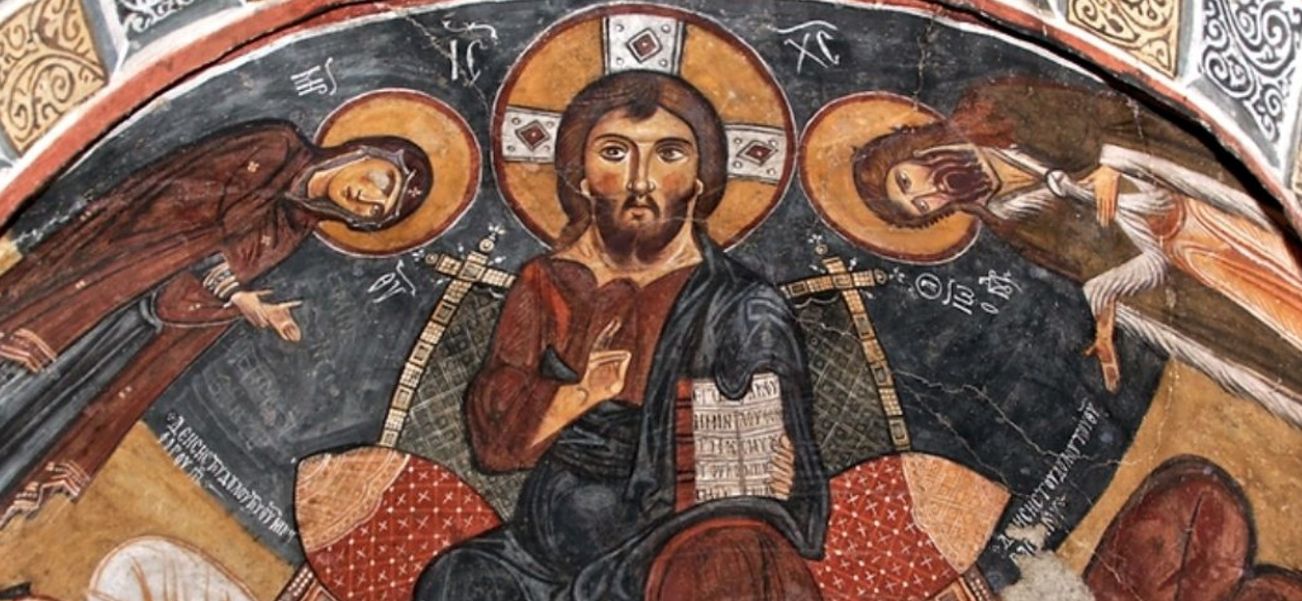
The stone walls demanded color. From the 9th to 11th centuries, Cappadocia became a gallery of Byzantine art. In a largely illiterate society, frescoes were the “Bible of the Illiterate.”
- Technique & Symbolism Painted on wet plaster (*fresco*), the scenes were rich in code. Christ Pantocrator (Ruler of All) dominated the dome. Blue symbolized the divine; gold, uncreated light. Narrative cycles detailed the life of Christ, the Gospels, and saints.
- The Crown Jewel: The Dark Church (Karanlık Kilise) Its name reveals the secret to its miraculous preservation. With minimal light, its 11th-century frescoes retained staggering vibrancy. The scene of the Anastasis (Resurrection), where Christ pulls Adam and Eve from their tombs, is a masterpiece of emotion and color, considered the pinnacle of Cappadocian Byzantine art.
- Surviving Iconoclasm During the 8th-century Iconoclastic period, figurative art was banned as idolatry. In Cappadocia, some faces were scratched out. Yet, the rock protected the images, allowing them to be rediscovered and revered after the ban was lifted.
VII. Beyond Göreme: Sacred Valleys and Monasteries

The spiritual landscape extends far beyond Göreme.
- Ihlara Valley A 14km gorge with a rushing river, housing over 100 rock-cut churches. The setting allowed for a unique blend of ascetic solitude and community life. Frescoes here, like in the Ağaçaltı Church, often include donor portraits, blending the sacred with the local.
- Selime Monastery The largest rock-cut monastery in Cappadocia, featuring a cathedral-scale church with massive columns. Its strategic location highlights its role as both a religious and defensive stronghold at the end of the Ihlara Valley.
VIII. Layers of History: From Christianity to Islam

History flowed over Cappadocia. Arab raids from the 7th century brought instability. The 11th-century arrival of the Seljuk Turks introduced a new chapter. This transition wasn’t merely destruction; it was often transformation and coexistence.
- Some churches were abandoned, slowly sealed by calcite deposits.
- Others were adapted; a mihrab (Islamic prayer niche) might be carved into a Christian apse.
- Seljuk caravanserais rose along old trade routes, adding a new architectural layer to the sacred geography. Cappadocia became a palimpsest of faith, where symbols from different worlds sometimes share the same wall.
IX. Modern Pilgrimage: Preservation in the Age of Tourism

Cappadocia’s rediscovery by Western travelers in the 19th century began a new era. Today, it faces the double-edged sword of global fame. Mass tourism provides essential revenue for preservation but also threatens the fragile microclimates that protect the frescoes.
- Conservation Challenges Humidity from breath, erosion from touch, and light exposure are constant battles.
- UNESCO and Beyond The UNESCO World Heritage status aids protection efforts, relying on careful visitor management, scientific conservation, and raising awareness.
- The Spiritual Tourist Modern visitors often seek more than a photo; they seek the palpable silence and awe of these ancient sanctuaries, continuing a tradition of pilgrimage that is centuries old.
Conclusion: The Eternal Whisper in the Rock

Cappadocia is more than an open-air museum. It is a profound dialogue between earth and spirit. From the desperate ingenuity of the underground cities to the serene theology of the Cappadocian Fathers, from the vibrant frescoes of the Dark Church to the silent, echoing halls of Selime Monastery, this land tells a universal story of the human quest for the divine.
It teaches that faith can be both hidden and monumental, that art can be an act of resistance, and that stone can hold a memory more enduring than empires. To walk through the Rose Valley at dusk, or to stand in a cool, painted chapel, is to hear the eternal whisper in the rock—a testament to the enduring power of sacred Anatolia. It invites us not just to see, but to listen, and to carry forward the respect that such a legacy demands.
Enjoy your trip to cappadocia!
Turkish Language Materials