


Best Cave Churches in Cappadocia: A Journey Through Rock-Cut Faith & Byzantine Art
In the heart of Turkey, the otherworldly landscape of Cappadocia unfolds like a vision from a dream. Famous for its “fairy chimney” rock formations and colorful hot air balloons, this region holds a deeper, more ancient secret within its soft volcanic stone. Cappadocia is a UNESCO World Heritage Site not merely for its geology, but for its breathtaking collection of Byzantine-era cave churches, a stunning testament to early Christian faith, resilience, and artistic genius.
Between the 4th and 11th centuries, devout communities, monks, and artists turned the region’s malleable rock into sanctuaries of worship and reflection. Fleeing Roman persecution and later seeking ascetic isolation, they carved not just simple chapels, but entire monastic complexes adorned with vivid frescoes depicting biblical narratives. These paintings, preserved for centuries in the dry, stable environment of the caves, form one of the world’s most significant collections of Byzantine art.
This guide will take you on a journey through the most iconic and awe-inspiring Cappadocia cave churches. We’ll explore the history behind their creation, decode the stories in their frescoes, and provide practical advice for your pilgrimage. Prepare to discover how faith literally moved mountains, leaving behind a spiritual and artistic legacy carved in stone.
BEST CAVE CHURCHES IN CAPPADOCIA: SACRED SPACES CARVED IN STONE
Cappadocia in 7 Days: The Ultimate 7-Day Cappadocia Itinerary for an Unforgettable Trip
Why Cappadocia Has So Many Cave Churches

The proliferation of rock-cut churches in Cappadocia is no accident. It is the convergence of historical necessity, spiritual fervor, and perfect geology.
Early Christianity in Anatolia
The apostles Paul and Peter are said to have traveled through Anatolia, and Cappadocia became an important early Christian center. By the 4th century, it was home to the Cappadocian Fathers—Saint Basil the Great, Saint Gregory of Nazianzus, and Saint Gregory of Nyssa—theologians who shaped Christian doctrine and championed monasticism.
Roman Persecution & Hidden Worship
Before Emperor Constantine’s Edict of Milan (313 AD) granted religious tolerance, Christians faced periodic persecution. Cappadocia’s complex, easily concealed valleys and soft volcanic tuff rock provided the ideal location for secret worship. Carving churches into cliffs allowed communities to gather in safety, hidden from view.
The Rise of Monasticism
Following the Cappadocian Fathers, the region became a powerhouse of Byzantine monastic life. From the 4th to the 11th centuries, hundreds of monks sought ascetic solitude in the valleys, establishing hermit cells, refectories, and churches. This monastic golden age resulted in the dense concentration of religious structures we see today.
The Perfect Canvas
The region’s rock is the star of the show. Formed from compressed volcanic ash, Cappadocia’s tuff is soft enough to be carved with simple hand tools, yet hardens upon exposure to air. It is also highly porous, providing natural insulation (cool in summer, warm in winter) and perfect absorption for the plaster and pigments of frescoes, aiding in their remarkable preservation.
10 Epic Attractions & Experiences in Cappadocia
1. Göreme Open-Air Museum: The Heart of Cave Churches

No visit to Cappadocia is complete without exploring the Göreme Open-Air Museum, the epicenter of the region’s rock-cut heritage and a UNESCO World Heritage site. This compact valley functioned as a major Byzantine monastic complex between the 10th and 12th centuries, housing a community of monks and serving as an important pilgrimage site. It’s an unparalleled open-air gallery of Cappadocia Byzantine art.
Must-See Churches Inside Göreme
- Tokalı (Buckle) Church The largest cave church in Göreme, comprised of an Old Church (10th century) and a larger New Church (11th century). Its frescoes are a masterpiece of 10th-century Byzantine painting, featuring a brilliant blue background and a comprehensive, beautifully preserved cycle of Christ’s life.
- Elmalı (Apple) Church A small, cross-domed church from the 11th century. Its name is said to come from a red orb held by the Archangel Michael in a fresco, mistaken for an apple. The frescoes here are fine examples of the Iconoclastic-era recovery, with detailed portraits of saints and donors.
- Yılanlı (Snake) Church Named for a fresco depicting Saint George slaying a dragon (interpreted as a snake). This 11th-century church features striking frescoes of saints on horseback (the "striding saints") and scenes of Emperor Constantine and his mother, Helena.
- Barbara Church Dedicated to Saint Barbara, this church has a more rustic, symbolic style. Its red-ochre decorations, drawn directly on the rock, include geometric patterns, mythical animals, and military symbols, reflecting a possibly different artistic tradition or the preferences of its patron.
Highlights

The museum showcases the evolution of fresco styles in Cappadocia, from the symbolic pre-Iconoclastic art to the rich, narrative-driven paintings of the Middle Byzantine period. Key biblical themes include the Nativity, Baptism of Christ, Transfiguration, and Crucifixion.
- Best Time to Visit Arrive at opening time (8:00 AM) or in the late afternoon to avoid the largest tour groups.
- Ticket Tips Entrance requires a separate ticket. The Dark Church (Karanlık Kilise) is not included in the standard museum ticket and requires an additional fee—but it is worth every lira.
The Göreme Open-Air Museum: Cappadocia's Cave Churches & Spiritual Heartbeat
2. Dark Church (Karanlık Kilise): Cappadocia’s Best-Preserved Frescoes

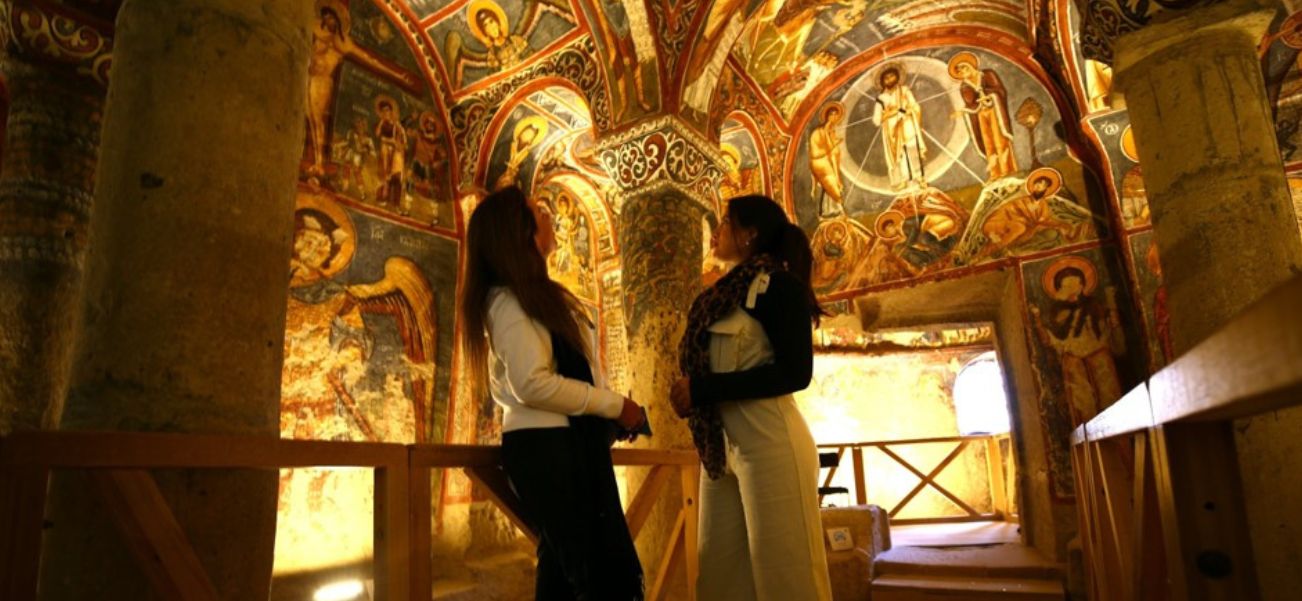
Tucked within the Göreme Open-Air Museum complex, the Dark Church justifies its additional entrance fee as the undisputed crown jewel of Cappadocian art. Its name derives from a single small window, allowing minimal natural light to penetrate. This very lack of light, along with centuries of pigeon guano that sealed the interior, acted as a perfect preservative for its 11th-century frescoes.
The interior is a breathtaking explosion of color. The frescoes, in near-original condition, depict a comprehensive New Testament cycle, including the Annunciation, Nativity, Baptism, Transfiguration, Entry into Jerusalem, Crucifixion, and Anastasis (Resurrection). The vibrancy of the blues, reds, and greens is unparalleled.
- Entrance & Photography Flash photography is strictly prohibited to protect the pigments. The low-light conditions mean photos without a tripod (often not allowed) are challenging; it’s best to simply absorb the beauty with your own eyes.
- Why it’s the Finest The artistic quality, completeness of the narrative cycle, and miraculous state of preservation make the Dark Church not just Cappadocia’s finest, but one of the best-preserved examples of Middle Byzantine art in the world.
Cappadocia Hot Air Balloon Rides
3. St. Basil’s Church: A Tribute to Cappadocian Christianity

Located at the entrance of the Göreme Museum, St. Basil’s Church is dedicated to one of the Cappadocian Fathers, Saint Basil the Great (c. 329-379 AD). As the Bishop of Caesarea (modern Kayseri), he established monastic rules that influenced Eastern Christianity profoundly.
The church itself is architecturally simple—a single nave with a burial chamber. Its frescoes, from the 11th century, are less ornate than those in the Dark Church but carry deep symbolic meaning. They include portraits of Saint Basil, Saint George, and Saint Theodore on horseback. The inclusion of Saint Basil directly connects this rock-cut space to the region’s most influential theological heritage, grounding the physical landscape in its spiritual history.
4. Çavuşin Church (St. John the Baptist Church)

Venture north of Göreme to find one of the oldest cave churches in Cappadocia. Çavuşin Church dates to the 5th century, with frescoes from later periods. Its location is dramatic, set high in a cliff face (accessed by a modern staircase), offering panoramic views of the valley.
The church is large and somewhat austere, reflecting its early origins. A partial collapse of the cliff face exposed the narthex, adding to its rugged character. Inside, you can see the evolution of fresco art, with 7th-century paintings in the apse and 10th-century additions. It provides a powerful sense of the scale and ambition of Cappadocia’s earliest Christian builders.
5. El Nazar Church: A Hidden Gem Near Göreme

For those seeking a quieter experience away from the museum crowds, El Nazar Church is a perfect choice. This 10th-century church, hidden in a fairy-chimney cone a short drive from Göreme, is a small but exquisite gem.
Its name means “the evil eye.” The interior is a single chamber adorned with vividly colored and well-preserved frescoes depicting scenes from the life of Christ, including a beautiful Deesis (Christ with Mary and John the Baptist) in the apse. The intimacy of the space and the clarity of the art make it a profoundly moving stop. It stands as a reminder that beyond the great monastic centers, countless smaller, independent churches served local communities.
6. Ihlara Valley Cave Churches: Faith Along the River

A stark contrast to the arid valleys around Göreme, the Ihlara Valley is a lush, 14-kilometer-long canyon carved by the Melendiz River. Its sheer cliffs contain over 100 rock-cut churches and dwellings, making it one of the largest such concentrations in Cappadocia. The combination of flowing water, greenery, and sacred spaces creates a uniquely serene atmosphere for exploration.
Notable Churches
- Ağaçaltı Church (Church Under the Tree) Known for its beautiful 9th-century frescoes in a rare “Syriac style,” with a dominant red color scheme and expressive faces.
- Sümbüllü Church (Hyacinth Church) An 11th-century church with frescoes featuring the lives of Christ and the Apostles in detailed, classic Byzantine style.
- Kokar Church (Fragrant Church) Named for the lingering scent of incense, it contains 9th-11th century frescoes, including a striking depiction of the Ascension.
What Makes Ihlara Unique
The valley’s churches served a more mixed population of monks and permanent settlers. Consequently, some frescoes include rare glimpses of daily life in Cappadocia alongside religious iconography. The best way to experience it is via the walking path from the main entrance down to the river, visiting churches along the way, and perhaps enjoying a tea at a riverside cafe.
7. Selime Monastery: A Cathedral Carved Into a Cliff

At the end of the Ihlara Valley lies the monumental Selime Monastery, the largest rock-cut monastery in Cappadocia. This is not a single church but a vast complex including a cathedral-sized church, a kitchen with a giant chimney, stables, living quarters, and a defensive network.
The scale is breathtaking. The main church features two colossal pillars and impressive, though more weathered, frescoes. Its strategic position at the valley’s mouth highlights its role in controlling ancient trade routes. For a fun, if apocryphal, fact: the dramatic landscape of Selime is rumored to have inspired the filmmakers of "Star Wars: Episode I" for a Tatooine scene. Climbing through its multiple levels feels like exploring a fortress, offering a complete view of monastic self-sufficiency.
How to Visit Cappadocia’s Cave Churches
- Guided Tours vs. Independent Exploration A knowledgeable licensed local guide is invaluable for understanding the historical context, theology, and art. For key sites like Göreme Museum, a guide enhances the experience immensely. Independent exploration is possible with a good guidebook and is ideal for places like Ihlara Valley or the scattered churches in the Love, Rose, and Red Valleys.
- Dress Code & Respect These are sacred historical sites. Modest dress is required—shoulders and knees should be covered for both men and women. Speak quietly, avoid touching the frescoes (skin oils damage them), and follow all signage.
- Photography Tips Flash photography is almost always forbidden inside churches. Use a high ISO setting and steady your camera, but be prepared for low-light challenges. Often, the best “photo” is a mental one.
- Best Seasons Spring (April-June) and Autumn (September-October) offer the most pleasant temperatures for hiking and exploring. Summer can be extremely hot and crowded, while winter offers a magical, quiet atmosphere with possible snow, though some paths may be slippery.
Tips for Responsible Tourism
The cave churches are incredibly fragile. Their preservation for future generations is a shared responsibility.
- Protect the Frescoes Never touch, lean on, or mark the paintings. The oils from human skin can cause irreversible damage.
- Stay on Marked Paths This protects both the archaeological sites and yourself from unstable terrain.
- Support Preservation Your entrance fees contribute to conservation efforts. Consider donating to reputable cultural heritage organizations.
- Choose Local Guides Hiring local experts supports the community and ensures accurate, respectful storytelling.
Conclusion: Cappadocia’s Living Stone Testament
The cave churches of Cappadocia are more than a tourist attraction; they are a living stone testament to human devotion, creativity, and endurance. They tell a story of communities who sought the divine in the very fabric of their landscape, transforming caves into celestial visions with pigment and faith.
To stand in the silent, cool darkness of the Dark Church, or to gaze up at the weathered faces of saints in Çavuşin, is to connect across centuries. It is an encounter with the spiritual silence and timeless beauty of Byzantine Cappadocia. This journey through rock-cut faith is an invitation to walk slowly, look deeply, and marvel at how, for generations, the heart of this region has beat not just in its extraordinary geology, but in the sacred spaces carved softly within it. Explore them with curiosity, tread lightly, and let the art on these ancient walls speak its timeless story.
Enjoy your trip to Capapdocia
Turkish Language Materials