Ottoman Empire: Successor of the Roman Empire? The Ultimate Historical Debate
The fall of Constantinople in 1453 is one of history’s most seismic events. The image of Mehmed II, the young Ottoman Sultan, entering the legendary city on May 29th is etched into the collective memory of the world. For many, it marks a clean, brutal break: the final death knell of the Roman Empire, a civilization that had endured for nearly two millennia. For others, however, particularly for Mehmed II himself, it was not an end, but a transformation. It was the moment the Ottoman Empire consciously and deliberately stepped into the shoes of its ancient predecessor, claiming the ultimate imperial legitimacy.
The question of whether the Ottoman Empire was a true successor to the Roman Empire is one of history’s most fascinating and complex debates. It’s a puzzle that sits at the intersection of geopolitical strategy, cultural transmission, religious identity, and raw power. It forces us to ask: What makes an empire "Roman"? Is it the land it controls? The laws it enforces? The faith it professes? Or is it simply the unbroken thread of imperial authority?
This is not a question with a simple yes or no answer. It is an exploration of claims and counterclaims, of symbolic gestures and hard political realities. Let's dive into the ultimate historical debate.
Was the Ottoman Empire the Successor of the Roman Empire? The Truth Behind the Imperial Legacy
Listen to this podcast about "Was the Ottoman Empire successor of the Roman Empire?"
I. THE CASE FOR THE OTTOMANS AS ROMAN SUCCESSORS: THE "YES" ARGUMENT
Proponents of the "successor" theory point to a powerful combination of deliberate policy, symbolic acts, and structural continuities that the Ottomans engineered following their conquest.
1. The Conquest as a Legal and Symbolic Transfer of Power

In the pre-modern world, conquest was often seen as a legitimate, if brutal, form of political succession. The Ottoman capture of Constantinople was framed not merely as a victory over a foreign enemy, but as the reclaiming of the Roman Empire's rightful capital.
- Mehmed II, "Kayser-i Rûm" (Caesar of Rome) This title was not a later historical invention. Mehmed II adopted it immediately after the conquest and used it officially. By declaring himself Caesar of Rome, he was making a direct legal claim to the Roman imperial throne. He argued that with the death of the last Palaiologos emperor, Constantine XI, in battle, the throne was vacant, and he, as conqueror, had the right to claim it.
- The "Third Rome" Theory, Ottoman-Style The famous "Third Rome" theory, developed in Moscow, claimed that with the fall of Constantinople to the "schismatic" Catholics (a reference to the Union of Florence) and then the Ottomans, religious and imperial authority had passed to the Orthodox Tsars of Moscow. Mehmed II presented a counter-narrative: Constantinople had not "fallen" in a spiritual sense; it had been liberated from its weakened Greek rulers and their flirtations with the Latin West, and was now restored to its former glory under a new, vigorous dynasty. In this view, the Ottoman Empire *was* the continuation of the Roman state, with its capital rightfully in Constantinople.
- Absorption of the Imperial Bloodline Mehmed made a point of integrating the remaining Byzantine nobility into his new regime. He claimed the Byzantine official Loukas Notaras as his Grand Vizier (though this relationship soured dramatically). More symbolically, he married a princess from the Byzantine Komnenos dynasty, thus literally marrying into the bloodline of previous Roman emperors and solidifying his dynastic legitimacy.
2. The Adoption of Roman Imperial Administration and Law

The Ottomans were pragmatists. They inherited a vast, complex, and ancient administrative machinery in the former Byzantine lands and, rather than dismantling it, they absorbed and adapted it.
- The Millet System: A Roman Precedent? The Ottoman millet (nation) system, which allowed religious communities (like the Greek Orthodox Rum Milleti) to govern their own internal affairs under their own religious leaders, can be seen as a direct evolution of late Roman and Byzantine practice. The Byzantine Empire had long granted certain legal autonomies to different ethnic and religious groups. The Ottomans systematized this, with the Ecumenical Patriarch of Constantinople, now residing in the Ottoman capital, becoming the political and religious leader of all Orthodox Christians in the empire. This was a continuation of the Byzantine model of the Emperor and the Patriarch working in symphony (or tension) to govern.
- Continuity of Bureaucracy Many Greek bureaucrats, tax collectors, and administrators kept their jobs, simply switching allegiance from the Byzantine Emperor to the Ottoman Sultan. The day-to-day governance of the Balkans and Anatolia continued with remarkable continuity, just with Turkish at the top of the administrative hierarchy instead of Greek.
- Land and Tax Law The Ottoman timar system, a form of land grant to cavalrymen in exchange for military service, bore striking similarities to the late Roman and Byzantine pronoia system. Both were methods of raising and maintaining a provincial army without a vast central treasury, tying military obligation to land tenure.
3. The Physical and Ceremonial Inheritance of Rome

The Ottomans understood the power of symbols and physically embedded themselves into the Roman imperial tradition.
- Constantinople as the New/Continued Capital The most powerful symbol was the city itself. Mehmed II did not sack Constantinople and move on; he made it his capital, Kostantiniyye (a name used officially alongside the colloquial "Istanbul"). He immediately began a massive repopulation and rebuilding campaign, restoring the city's economic and strategic vitality. He was, in effect, performing the primary duty of a Roman Emperor: being the guardian and builder of the Queen of Cities.
- The Use of the Hippodrome The ancient Hippodrome, the ceremonial heart of the Byzantine Empire, became the ceremonial heart of the Ottoman Empire. The three great ancient monuments—the Egyptian Obelisk, the Serpent Column, and the Masonry Obelisk—were preserved. Ottoman imperial processions, such as the circumcision ceremonies for princes, were held there, directly appropriating the space's ancient imperial symbolism.
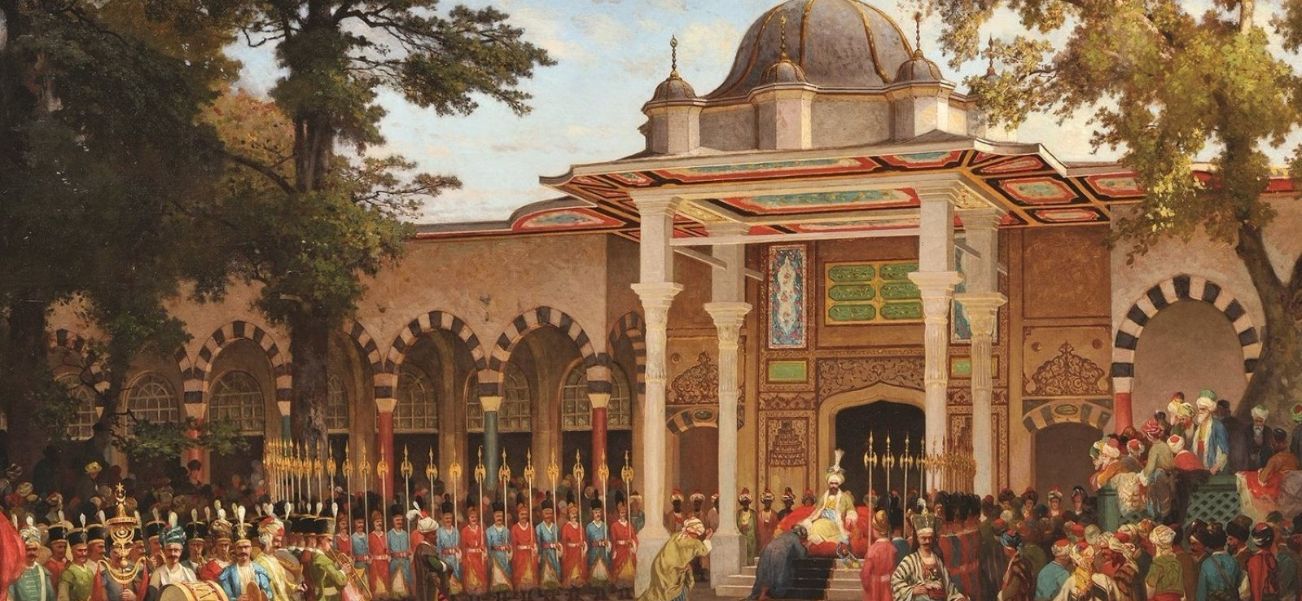
- Adoption of Byzantine Court Ceremonial The highly elaborate and rigid court ceremonial of the Byzantine Emperors, designed to project an image of the ruler as a semi-divine figure remote from ordinary mortals, was largely adopted by the Ottoman court at Topkapi Palace. The emphasis on hierarchy, silence, and ritualized access to the Sultan was deeply reminiscent of the old Great Palace of Constantinople.
4. Geopolitical and Military Continuity

From a strategic perspective, the Ottoman Empire simply took over the geopolitical role of the Eastern Roman Empire.
- The Same Enemies The Ottoman Empire found itself fighting the same primary adversaries as the later Byzantine Empire: the Venetian Republic and the Habsburg Empire in the West, and various successor states in the Balkans. The "Long War" between the Ottomans and the Habsburgs was, in many ways, a continuation of the ancient Roman-Persian and then Roman-Islamic frontier conflicts, now transposed to Central Europe.
- Control of the Same Territory At its height, the Ottoman Empire controlled almost all the core territories of the Eastern Roman Empire at its peak under Justinian: Anatolia, the Balkans, Egypt, the Levant, and North Africa. They ruled over the same diverse populations of Greeks, Slavs, Armenians, and Arabs that the Byzantines had struggled to manage.
II. THE CASE AGAINST THE OTTOMANS AS ROMAN SUCCESSORS: THE "NO" ARGUMENT
Despite the compelling evidence above, a powerful counter-argument insists that the differences between the Ottoman and Roman empires were far more profound than the similarities, making the idea of true succession untenable.
1. The Irreconcilable Divide: Religion and Civilization

This is the most significant argument against succession. The Roman Empire, from the 4th century onwards, was fundamentally a Christian empire. Its identity was inextricably linked to Orthodox Christianity.
- A Muslim Caesar? For contemporary Christian Europe, the idea of a Muslim ruler claiming the title of the Christian Roman Emperor was an absurdity and a blasphemy. The Pope and the Western European monarchs never recognized Mehmed's claim. To them, he was the "Great Turk," an infidel conqueror, not a legitimate emperor. The Roman Empire was, in their view, the defender of Christendom, and the Ottomans were its greatest enemy.
- The "Clash of Civilizations" Narrative From this perspective, 1453 was not a succession but a civilizational cataclysm. The heart of Eastern Christendom was now the seat of a Sunni Islamic Caliphate (a title the Ottomans would later claim more forcefully). The great church of Hagia Sophia, the supreme symbol of Byzantine Christianity, was converted into a mosque. This was not continuity; it was a definitive and violent break.
2. The Question of the "Byzantine" vs. "Roman" Legacy

Modern historians often distinguish between the classical Roman Empire and its medieval continuation, the Byzantine Empire. Critics of the succession theory argue that even if the Ottomans succeeded the Byzantines, this is not the same as succeeding the Romans of antiquity.
- Loss of Latin Heritage The classical Roman Empire was fundamentally Latin in its legal, administrative, and early cultural foundations. While the Byzantine Empire preserved Roman law, its culture was overwhelmingly Greek. The Ottoman Empire inherited this Greek-influenced Byzantine structure, but it had almost no connection to the original Latin core of the Roman Republic and early Empire. Key Roman institutions like the Senate were long gone by 1453.
- A Different Imperial Model The Ottoman state was built on a fundamentally different model. Its core institutions—the devşirme (child-levy) system that created the Janissaries and the administrative elite, the centrality of the Sultan-Caliph, and its basis in Islamic law (Sharia) and Turkish ghazi (warrior for the faith) traditions—were alien to the Roman world.
3. The Problem of Recognition and Legitimacy

In the pre-modern world, legitimacy was often a matter of recognition by peers.
- No Recognition from the West As stated, no Christian power recognized the Ottoman claim. The Holy Roman Empire in the West, which saw itself as the true continuation of the Roman imperial title (despite Voltaire's famous quip that it was "neither Holy, nor Roman, nor an Empire"), was the Ottomans' primary rival.
- No Recognition from the East (Initially) Within the Islamic world, the Ottomans were initially just one among many powerful Turkish states. Their claim to Roman succession would have held little weight with the Mamluk Sultanate of Egypt or the Safavid Empire of Persia. Their legitimacy in the Muslim world was initially based on their status as successful ghazis, not as Roman Kaysers.
III. THE NUANCED MIDDLE GROUND: NOT A SUCCESSOR, BUT A HEIR

Perhaps the most accurate way to view the relationship is to introduce a crucial distinction: the Ottoman Empire was not the continuation of the Roman Empire, but it was undoubtedly its heir.
Heir vs. Successor A successor implies a direct, legal, and institutional continuity. An heir, however, inherits the property, the titles (even if contested), and the responsibilities of the deceased, but remains a distinct entity. The Ottoman Empire was the primary heir to the Eastern Roman Empire. It inherited its capital, its core territories, many of its administrative practices, and its geopolitical dilemmas.
A Syncretic Empire The Ottoman state was a unique and powerful synthesis. It was not purely Turkish, nor purely Islamic, nor purely Roman. It was a fusion of all these elements:
- Turkish in its dynastic origins and military ethos.
- Islamic in its religious law and the Caliphal authority it later claimed.
- Roman in its imperial pretensions, its administrative structures in the Balkans and Anatolia, and its geopolitical posture.
- The "Roman" Identity of the Ottoman Empire's Christian Subjects For the conquered Greek, Slavic, and Albanian Christians, the Sultan was the "Basileus" (Emperor) in a political sense. They were the Rum Milleti, the "Roman nation." Their identity as "Romans" ("Romaioi") persisted under Ottoman rule, preserved by the Orthodox Church. In this way, the Roman identity lived on within the empire, even if the state itself was Islamic.
CONCLUSION: A LEGACY OF COMPLEXITY AND ENDURING FASCINATION

So, was the Ottoman Empire the successor of the Roman Empire? The answer depends entirely on the definitions we use.
If "Roman" means the Christian, Latin-influenced empire of antiquity, then the answer is a clear no. The religious and fundamental civilizational chasm is too wide to bridge.
However, if "Roman" is defined by imperial universality, control of the city of Constantinople and its hinterlands, a specific set of administrative practices in the Eastern Mediterranean, and a direct claim to the title of Caesar, then the Ottoman Empire makes a surprisingly strong case. Mehmed II's self-conscious modeling of his rule on Roman precedents cannot be dismissed as mere propaganda; it was a serious political project to ground his new empire in the most prestigious legacy available.
Ultimately, the debate itself is a testament to the enduring power of the Roman idea. Long after the legions were gone and the classical world had faded, the title of "Caesar" and the dream of universal empire remained the ultimate political prize. The Ottomans, like the Russians and the Holy Roman Emperors before them, sought to claim that prize. They may not have been the Roman Empire reborn, but they became its most formidable and fascinating heir, weaving its legacy into the very fabric of their own magnificent and enduring civilization. The fall of Constantinople in 1453 did not end the story of Rome; it simply opened a new, contentious, and profoundly important chapter.
Turkish Language Materials