


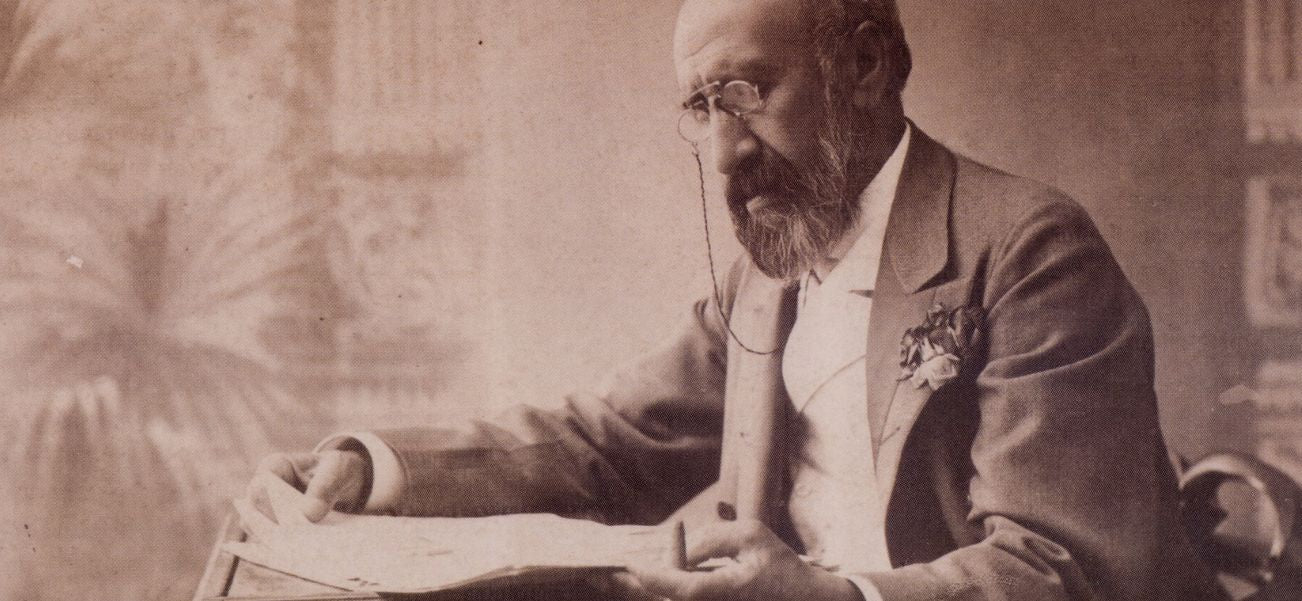
Osman Hamdi Bey: Ottoman Artist, Archaeologist & Founder of Istanbul Archaeological Museums
In an era when the Ottoman Empire was often depicted by the West as the "Sick Man of Europe," a singular figure emerged, armed with a paintbrush, a trowel, and an unwavering vision. Osman Hamdi Bey (1842–1910) was not merely an artist or an archaeologist; he was a cultural architect who forged a modern Ottoman identity at the crossroads of civilizations. At a time of profound political fragility, he crafted a powerful narrative of intellectual sophistication, historical depth, and artistic excellence that challenged Orientalist fantasies and asserted his homeland’s place in world history.
Why does Osman Hamdi Bey still resonate so powerfully today? In our globalized world, where questions of cultural representation, heritage ownership, and national identity remain fiercely relevant, his life’s work offers a masterclass in agency, synthesis, and preservation. He was a bridge between East and West, not as a passive conduit, but as an active interpreter who selectively adapted Western techniques to express and protect a distinct Ottoman worldview. He mastered the languages of European academia and archaeology, only to use them to articulate a self-determined image of his own culture and to legislate the protection of its ancient legacy.
This article delves into the three intertwined pillars of his genius: Osman Hamdi Bey the Painter, whose canvases presented a nuanced, dignified counter-narrative to Western Orientalism; Osman Hamdi Bey the Archaeologist, whose groundbreaking excavations recovered magnificent artifacts like the Alexander Sarcophagus; and Osman Hamdi Bey the Museum Founder, who established the Istanbul Archaeological Museums and championed revolutionary heritage laws. We will explore how this one man’s multidisciplinary mission helped shape the cultural consciousness of modern Turkey, ensuring that the empire’s past was not plundered but preserved, studied, and proudly displayed for generations to come.
OSMAN HAMDI BEY: THE OTTOMAN VISIONARY WHO REDEFINED ART, ARCHAEOLOGY & CULTURAL IDENTITY
Listen to the podcast about "Osman Hamdi Bey":
Istanbul Archaeological Museums: A Portal to Ancient Civilizations
I. Who Was Osman Hamdi Bey? Early Life & Background
Osman Hamdi was born in 1842 in Constantinople (Istanbul), the son of Ibrahim Edhem Pasha, a Grand Vizier who had risen from being a Greek orphan on the island of Sakız (Chios) to the highest administrative rank in the empire. This extraordinary family background is crucial: it instilled in Osman Hamdi a profound belief in meritocracy, reform, and the transformative power of education within the Ottoman framework.
Breaking from tradition, his father sent him to Paris in 1860 to study law. However, the young Osman Hamdi was quickly captivated by the city’s vibrant artistic and intellectual scene. He abandoned law to train as a painter, studying under renowned academic masters like Gustave Boulanger and Jean-Léon Gérôme. This education immersed him in the techniques of French Orientalism—a genre obsessed with depicting the "exotic" East. Yet, as an Ottoman subject, he observed this fascination from a unique dual perspective: as an insider to the culture being depicted and as a trained practitioner of the style depicting it.
His years in Paris were formative, exposing him to Western archaeology, museology, and intellectual debates. He returned to the Ottoman Empire not as a mere imitator of European trends, but as a synthesizer, equipped with modern tools and a fierce determination to apply them for the benefit of his own society’s cultural development.
Ottoman Palaces: Exploring Imperial Heritage in Istanbul
II. Osman Hamdi Bey as an Ottoman Painter
A. Artistic Style & Influences
Hamdi Bey’s painting technique was grounded in the academic realism of his French teachers. His canvases are meticulously composed, with precise draftsmanship and a rich, controlled palette. He employed the visual language of Orientalism—intricate architectural settings, detailed textiles, scholarly props—but subverted its very essence. While Western Orientalists often portrayed a sensual, decadent, and static Orient for Western consumption, Hamdi Bey offered an internal perspective. His scenes are contemplative, intellectual, and dignified. He used architecture not as mere backdrop but as a character itself, filling his compositions with authentic Ottoman tiles, calligraphy panels, and furniture to create a sense of historical and cultural specificity.
B. Famous Paintings by Osman Hamdi Bey
- The Tortoise Trainer (Kaplumbağa Terbiyecisi) (1906 & 1907) His most iconic work. It depicts an elderly dervish in a dim, Seljuk-era hall, attempting to train tortoises with a *ney* (reed flute). Widely interpreted as a poignant allegory for the slow, frustrating pace of reform in the late Ottoman Empire, it symbolizes the enlightened reformer’s struggle against ingrained tradition.
- Girl Reading the Quran (1880) A powerful depiction of female literacy and piety. A young woman is shown deeply engrossed in reading, challenging Western stereotypes of oppressed, uneducated Ottoman women. The setting is domestic yet scholarly, emphasizing quiet intellectual pursuit.
- The Arms Merchant & The Keeper of the Mausoleum These works continue his theme of dignified, professional individuals engaged in trade or custodianship. They are portraits of a complex, functioning society, filled with artisans, scholars, and merchants, far removed from the harem fantasies of European painters.
His paintings are layered with symbolism and subtle social criticism. They advocate for education, women’s intellectual engagement, and thoughtful modernization, aligning with the reformist ("Tanzimat") ideals of his circle.
C. Breaking Stereotypes in Orientalist Art
Hamdi Bey’s greatest artistic achievement was his humanization of Ottoman subjects. He portrayed men as contemplative scholars, not despotic pashas; women as educated readers, not odalisques. By doing so, he directly challenged European misconceptions and asserted a self-representation rooted in reality and pride. His art was a reclaiming of the gaze, using the West’s own artistic vocabulary to tell the East’s own story.
III. Osman Hamdi Bey the Archaeologist
A. Early Archaeological Work
Appointed director of the Imperial Museum ("Müze-i Hümayun") in 1881, Osman Hamdi Bey entered a field dominated by European archaeologists who freely exported finds. He transformed Ottoman involvement from passive permission-granting to active, scientific leadership.
B. Major Excavations
His most famous campaign was at the Royal Necropolis of Sidon (modern-day Lebanon) in 1887. Here, he made a discovery that stunned the archaeological world: a series of magnificent ancient sarcophagi, including the breathtaking Alexander Sarcophagus. Ironically named not for its occupant (likely King Abdalonymos of Sidon) but for its intricate bas-reliefs depicting Alexander the Great in battle and hunt, this 4th-century BC masterpiece is considered one of the finest examples of Hellenistic art. Its discovery, led by an Ottoman, proved the empire’s capacity for world-class scientific scholarship.
C. Protecting Ottoman Heritage
Hamdi Bey’s excavations were methodical and documented. More importantly, he ensured that these priceless finds, unlike so many before them, remained within the empire. The arrival of the Sidon sarcophagi in Istanbul was a triumphal event, symbolizing a new era of cultural sovereignty.
IV. Founder of Istanbul Archaeological Museums
A. Birth of a Modern Museum System
Osman Hamdi Bey’s vision required a proper home. He championed and oversaw the construction of the main building of the Istanbul Archaeological Museums, which opened in 1891. Designed by him and his architect in the neo-classical style, it was the first purpose-built museum in the Ottoman Empire and a landmark of modern museology.
B. Museum as a Cultural Statement
The museum was far more than a repository; it was a symbol of Ottoman modernization and enlightenment. It served an educational mission, making the empire’s layered history—Greek, Roman, Byzantine, Ottoman—accessible to the public and scholars alike. It stood as a physical assertion that this heritage belonged to and would be interpreted by the land that housed it.
C. Osman Hamdi Bey as Museum Director
He established rigorous scientific cataloging and preservation practices. He published scholarly catalogs of the collections, some in French to engage the international academic community. His policies created the foundation for Turkey’s modern museum administration, and his legacy is tangibly present in the galleries of the Istanbul Archaeological Museums today.
V. The 1884 Ottoman Antiquities Law
Perhaps his most enduring institutional achievement was the 1884 Asar-ı Atika Nizamnamesi (Antiquities Regulation). This revolutionary law:
- Declared all archaeological discoveries on Ottoman soil state property.
- Strictly ended the export of artifacts, dismantling the practice of "partage" (division of finds) that had enriched European museums.
- Established a system of permits and state supervision for excavations. This legislation was decades ahead of its time and forms the bedrock of modern Turkish cultural heritage laws. It fundamentally shifted the global power dynamics of archaeology and set a precedent for post-colonial nations worldwide.
VI. Osman Hamdi Bey’s Legacy in Modern Turkey
Osman Hamdi Bey’s influence extends far beyond his paintings and museums. He was a holistic cultural reformer.
- Art Education In 1882, he founded the Sanayi-i Nefise Mektebi (School of Fine Arts), now the Mimar Sinan Fine Arts University, Turkey’s first art academy. He structured its curriculum, shaping generations of Turkish artists.
- Cultural Icon Today, his image and works are omnipresent. "The Tortoise Trainer" is a national icon, reproduced everywhere. His paintings command record prices at auction, reflecting their enduring cultural and artistic value.
- National Identity He is rightly celebrated as a founding father of Turkey’s modern cultural infrastructure. He demonstrated that modernization did not require Westernization at the cost of identity, but could be achieved through a confident synthesis, preserving and reinterpreting one’s own heritage with modern tools.
VII. Visiting Osman Hamdi Bey Today
For the cultural traveler in Istanbul, engaging with Osman Hamdi Bey’s legacy is a profound experience.
- Istanbul Archaeological Museums (Gülhane, Fatih) Start here. See the magnificent Alexander Sarcophagus he discovered, wander the halls he built, and visit the museum's painting gallery to see several of his original works.
- Pera Museum (Beyoğlu) Houses a superb collection of Ottoman Orientalist art, including the famed 1907 version of The Tortoise Trainer.
- His House Museum in Gebze (Kocaeli) "Eskihisar Osman Hamdi Bey Konağı" is his former summer villa and studio, now a museum showcasing his life and work in a personal setting.
Including these sites offers a unique lens through which to understand the intellectual and cultural ferment of the late Ottoman Empire and the roots of modern Turkey.
VIII. Conclusion: The Man Who Preserved the Past and Painted the Future
Osman Hamdi Bey was a renaissance man of the Bosphorus. In an age of decline, he engineered a cultural renaissance. As a painter, he reclaimed his people’s image with dignity and depth. As an archaeologist, he unearthed monumental proof of the land’s ancient grandeur. As a museum founder and legislator, he built the institutions and laws to protect that legacy for the nation.
His genius lay in his synthesis. He did not reject the West nor cling uncritically to tradition. Instead, he mastered Western methods to serve an Ottoman vision—to educate, to preserve, and to assert a sophisticated identity on his own terms. He shaped the very way modern Turkey sees its past and its place in the world.
In today’s global discourse, where cultural heritage is both a treasure and a battleground, Osman Hamdi Bey’s legacy is profoundly relevant. He stands as a timeless reminder of the power of cultural agency, the importance of protecting one’s history, and the enduring truth that to move forward with confidence, a society must first possess a deep and authentic understanding of its own past. He preserved the past, and in doing so, he painted the blueprint for a future built on knowledge, identity, and pride.
Turkish Language Materials