
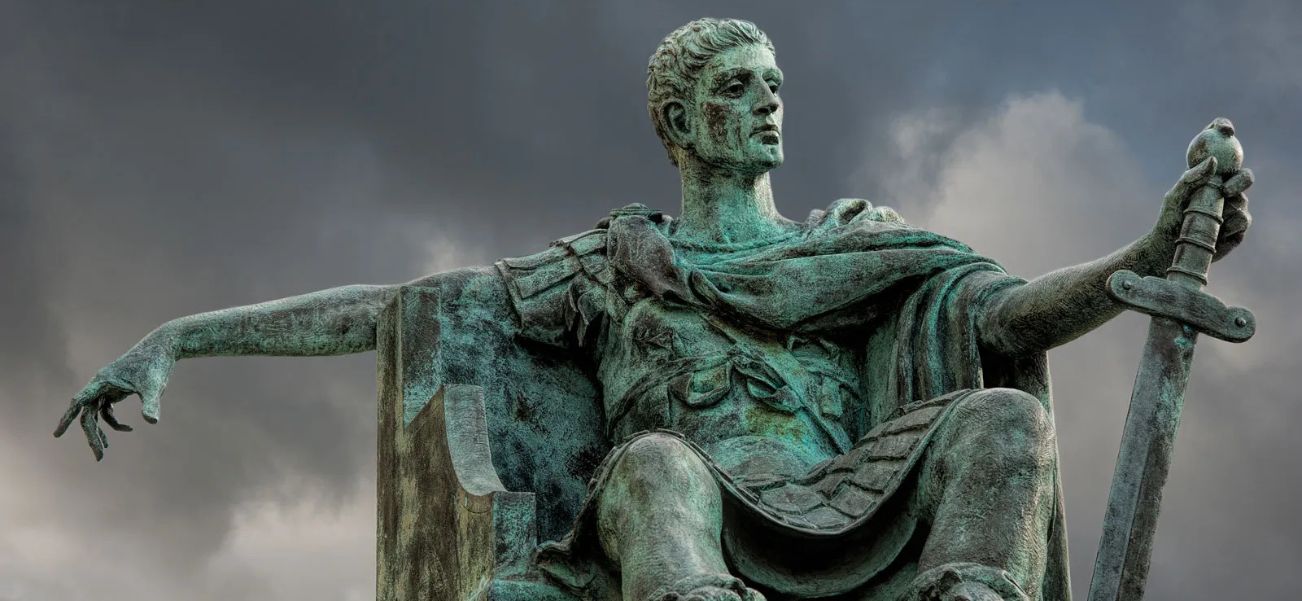
Constantine the Great: From Roman Emperor to Founder of Constantinople
In the long, turbulent annals of the Roman Empire, few figures stand as colossally transformative as "Flavius Valerius Constantinus", known to history as "Constantine the Great". His reign marks a profound pivot point, a moment where the classical world of the Caesars began its metamorphosis into the medieval world of Byzantium and Christendom. While his military victories and political acumen secured his power, his most enduring legacy is a city: "Constantinople". This was not merely the founding of a new urban center; it was the deliberate creation of a new heart for the Roman Empire, a "New Rome" that would carry the imperial flame for a thousand years after the fall of its western counterpart.
This blog post delves into the epic story of Constantine the Great, tracing his journey from a powerful claimant in the destructive Tetrarchy to the sole Roman Emperor who fundamentally reshaped the empire's religious, political, and geographical core. We will explore the pivotal Battle of the Milvian Bridge, his revolutionary Edict of Milan, and the strategic masterstroke that was the founding of Constantinople, a decision that echoes through the corridors of history to this day.
Constantine the Great: From Roman Emperor to Founder of Constantinople – The Man Who Forged a New Roman World
Listen to this podcast about "Constantine The Great":
The Pic History Of Turkey Through The Ages
The Crucible of Power: Constantine’s Ascent in the Tetrarchy
To understand the magnitude of Constantine’s achievements, one must first appreciate the chaos from which he emerged. The Roman Empire of the late 3rd and early 4th centuries was a realm under immense strain. A half-century of civil war, foreign invasion, and economic collapse, known as the Crisis of the Third Century, had nearly shattered the empire. The emperor Diocletian, a formidable organizer, attempted to solve this problem by inventing the Tetrarchy (rule of four). The empire was divided into eastern and western halves, each ruled by a senior Augustus and a junior Caesar. This system was designed to provide stable succession and better defense.
Recommended reading: Ottoman Empire: Successor of the Roman Empire? The Ultimate Historical Debate
Constantine was born around 272 AD in Naissus (modern-day Niš, Serbia). His father, Constantius Chlorus, rose through the ranks to become the Caesar, and later Augustus, of the Western Roman Empire. Constantine spent his youth at the court of Diocletian in the East, witnessing firsthand the intricacies and brutal realities of imperial politics. When Diocletian and his co-emperor Maximian unexpectedly abdicated in 305 AD, the carefully planned Tetrarchy began to unravel. Constantius Chlorus became Augustus of the West, but when he died just a year later in Eboracum (York, England), his legions immediately proclaimed his son, Constantine, as Augustus.

This act of acclamation set the stage for a new round of civil wars. Constantine was one of several powerful men vying for control. His most formidable rival in the West was Maxentius, the son of the former emperor Maximian, who held Rome. The conflict between them was not just a personal power struggle; it represented a clash between the old, pagan heart of Rome and the rising forces of change that Constantine would come to embody.
The Divine Sign: The Battle of the Milvian Bridge and the Conversion of Constantine
The year 312 AD proved to be the turning point in Constantine's life and, consequently, in world history. Marching from Gaul into Italy to confront Maxentius, Constantine faced an enemy who vastly outnumbered him. According to the accounts of the Christian historian Lactantius and the later chronicler Eusebius of Caesarea, Constantine experienced a profound divine vision on the eve of the decisive battle.
Lactantius states that Constantine was instructed in a dream to mark the heavenly sign of God on the shields of his soldiers. Eusebius provides a more detailed, and perhaps embellished, account: Constantine and his army saw a cross of light in the sky above the sun, inscribed with the Greek words "Ἐν Τούτῳ Νίκα" (En Toutō Níka), meaning "In this sign, conquer." That night, Christ appeared to Constantine, telling him to use the sign against his enemies.
Heeding this vision, Constantine ordered his troops to adorn their shields with the Chi-Rho symbol (☧), the first two letters of Christ's name in Greek. The ensuing Battle of the Milvian Bridge, just north of Rome, was a stunning victory for Constantine. Maxentius’s forces were routed, and Maxentius himself drowned in the Tiber River while attempting to flee.
Recommended reading: Uncovering Troy: Trojan War, Myth, Reality, or Something In Between
The victory at the Milvian Bridge was more than a military conquest; it was a religious and political earthquake. Constantine entered Rome as the undisputed master of the West. More importantly, he attributed his success to the God of the Christians. This moment is traditionally identified as the Conversion of Constantine, a pivotal event that set Christianity on the path to becoming the dominant religion of the Roman Empire.
In 313 AD, Constantine and his eastern co-emperor Licinius issued the Edict of Milan. This proclamation established a policy of religious tolerance throughout the empire, effectively ending the centuries of sporadic persecution of Christians. It granted Christians the right to practice their faith openly and restored confiscated property to Christian communities. The Edict of Milan was a revolutionary step, decoupling Roman identity from pagan state religion and paving the way for the Christianization of the empire.
The Vision of a New Rome: Why Constantinople?
With control over the Western Empire secure following his final victory over Licinius in 324 AD, Constantine became the sole ruler of the entire Roman world. He now faced the immense task of governing a vast, fractured realm. The old capital, Rome, was problematic for several strategic reasons:
- Geographical Peripheralization Rome was far from the empire's most critical frontiers—the Danube and the Euphrates. The real economic and military power had shifted eastward.
- Pagan Stronghold The city of Rome was the heart of the old pagan aristocracy. The Senate and many powerful families were deeply conservative and resistant to Constantine's Christian sympathies and reforms.
- Strategic Vulnerability Located inland, Rome was not easily defensible against the naval threats that were becoming more common. Its symbolic value also made it a target for usurpers.
Constantine needed a new capital—a city that was his from its foundation, free from the weight of pagan tradition, and perfectly positioned to administer the empire. His gaze fell upon the ancient Greek city of Byzantium, a modest but strategically located settlement on a peninsula at the southern entrance of the Bosphorus Strait.
Recommended reading: Göbeklitepe - Unraveling the World's First Temple and Rewriting Human History
The location was nothing short of geopolitical genius. It was a natural fortress, surrounded by water on three sides with a magnificent, defensible harbor known as the Golden Horn. It controlled the vital trade routes between Europe and Asia, and the Black Sea and the Mediterranean. As the historian Libanius later wrote, the city acted as "the bridge between the East and the West." Here, Constantine would build his Nova Roma (New Rome).
The Founding of Constantinople: A Ceremony of Cosmic Significance
On May 11, 330 AD, after years of frantic and lavish construction, Constantine officially dedicated the city of Constantinople (Constantinoupolis, "City of Constantine"). The ceremonies were meticulously planned to blend Roman tradition with Christian symbolism, signaling the birth of a new era.
According to tradition, Constantine himself led the ceremony to mark the new boundaries of the city. As the story goes, he marched with his court, and when his advisors asked how far he would expand the city walls, he replied that he would continue until "the one who walks before me stops." This was interpreted as a divine guide, perhaps an angel, leading the way. The new Theodosian Walls (built later) would eventually enclose a massive area, making Constantinople one of the largest and most fortified cities in the world.
The city was adorned with the spoils of the ancient world. Artwork, statues, and marble columns were stripped from temples and cities across the empire to beautify the new capital. The Hippodrome, modeled on the Circus Maximus in Rome, was expanded to host chariot races and public ceremonies, becoming the social and political heart of the city. At its center stood monuments like the Serpent Column from Delphi and the Egyptian obelisk.
Most significantly, Constantine began shifting the religious center of gravity. While he did not ban paganism—the city initially had its share of temples—he privileged Christianity. He built the first version of what would later become the magnificent Hagia Sophia (Church of Holy Wisdom), laying the foundation for the city's identity as the premier Christian capital. He also established the city as the seat of a new bishop, who would eventually become the Ecumenical Patriarch of Constantinople, a key figure in Eastern Christianity.
The city was organized into 14 regions, like Rome, and was granted its own Senate. To encourage rapid population growth, Constantine offered land grants and tax exemptions to wealthy families who would build homes and relocate. The result was an almost instantaneous metropolis, a melting pot of Greek, Roman, and Eastern cultures, with a thriving economy from day one.
The Dual Legacy: Constantine’s Impact on World History
Constantine the Great died in 337 AD, just seven years after the dedication of his city, but his work had already set an irreversible course for history. His legacy is complex and multifaceted, debated by historians for centuries.
1. The Christian Emperor:
Constantine's conversion was a watershed moment. He actively involved himself in church affairs, presiding over the First Council of Nicaea in 325 AD, which sought to resolve the Arian controversy and produced the Nicene Creed, a foundational statement of Christian belief still used today. By granting the church legal status and patronage, he transformed it from a persecuted sect into a powerful institution intertwined with the Roman state. This fusion of imperial and ecclesiastical power would define the Byzantine Empire for its entire existence.
2. The Founder of the Byzantine Empire:
While the Byzantine Empire considered itself simply the Roman Empire, historians mark its beginning with the founding of Constantinople. The city became the guardian of Roman law, Greek culture, and Christian orthodoxy for over a millennium. It was a bulwark against Persian, Arab, and Slavic invasions, preserving classical knowledge through the European Dark Ages. The Eastern Roman Empire, centered on Constantinople, would endure until 1453, outliving its western counterpart by a thousand years.
3. The Urban Planner and Legal Reformer:
Beyond his religious and political acts, Constantine was a significant administrator. He continued Diocletian's reforms, stabilizing the currency with the introduction of the gold "solidus", which became the standard for centuries. He also reformed the legal code, incorporating Christian principles, such as restrictions on crucifixion and gladiatorial games, and enacting laws that reflected a more humane view of the family.
The Echoes of a New Rome: Constantinople’s Enduring Influence
The city Constantine founded did not just survive; it thrived. For centuries, Constantinople was the largest, richest, and most cultured city in Europe. Its massive Theodosian Walls repelled countless armies. Its libraries preserved the works of Plato, Aristotle, and Homer. Its artisans created breathtaking mosaics, ivories, and silks.
The influence of Constantine's city radiated outward. The Cyrillic alphabet, used in Russia and much of Eastern Europe, was developed by Byzantine missionaries so that Slavic peoples could read the Bible. The architectural and religious traditions of Eastern Orthodoxy were codified within its walls, spreading to Russia, the Balkans, and the Caucasus. The Russian Tsars and the Russian Orthodox Church both claimed the spiritual and political mantle of Constantinople, styling Moscow as the "Third Rome" after its fall to the Ottomans.
Even after the Ottoman Sultan Mehmed the Conqueror captured the city in 1453, renaming it Istanbul, its strategic and symbolic importance never faded. It remained the capital of the Ottoman Empire until its dissolution in 1922. Today, as Istanbul, it is a vibrant modern metropolis where the remnants of Constantine's vision are still visible. The towering walls, the majestic Hagia Sophia (now a mosque), and the underground Basilica Cistern all stand as silent, powerful testaments to the day a Roman emperor decided to build a new capital and, in doing so, forged a new world.
Conclusion: The Architect of a Millennium
Constantine the Great was a figure of immense contradiction—a ruthless military commander and a devout convert, a traditional Roman ruler and a radical innovator. His victory at the Milvian Bridge and the subsequent Edict of Milan set Christianity on its path to global prominence. But it was his decision to found Constantinople that was his most tangible and enduring legacy.
He was not just building a city; he was transplanting the heart of the Roman Empire to a new body. He created a capital that was defensible, economically vibrant, and ideologically aligned with his vision for the future. In shifting the center of gravity from the Tiber to the Bosphorus, Constantine ensured that the Roman Empire, in its Eastern incarnation, would survive and flourish for another ten centuries, acting as a crucible where classical civilization, Christianity, and Eastern influences melded to create the unique and enduring culture of Byzantium. The story of Constantine is the story of the end of one era and the dramatic, calculated beginning of another—an echo that still resonates from the walls of his magnificent city.
Turkish Language Materials